AI use across the North American book industry 2026
The AI use across the North American book industry 2026 survey is an initiative from the Book Industry Study Group (BISG) and BookNet Canada, and is a continuation of the work done by the BISG AI Working Group in 2025. The survey provides an updated look at how the book industry is approaching AI. Building on the 2025 survey, this year’s results examine AI use at both the individual and organizational levels, the tools and environments being used, common and anticipated use cases, organizational policies and governance, education and training needs, and broader concerns and perceptions. The insights from this report will help organizations understand the current use of and attitudes towards AI and will help to create AI policies that are effective and aligned with industry values.
Table of Contents
- Introduction
- Background and context
- Definitions
- About the respondents
- Overview of AI use in the book industry
- Tools and environments
- Policies and governance
- Education, training, and best practices
- Top concerns and barriers to use
- Perceptions
- Approaching AI as an industry
- Open-ended responses analysis
- Final thoughts
- References
- About Book Industry Study Group
- About BookNet Canada
- Appendix A
Introduction
Executive summary
The AI Use Across the North American Book Industry 2026 survey is an initiative from the Book Industry Study Group (BISG) and BookNet Canada, and is a continuation of the work done by the BISG AI Working Group in 2025. The survey provides an updated look at how the book industry is approaching AI. Building on the 2025 survey, this year’s results examine AI use at both the individual and organizational levels, the tools and environments being used, common and anticipated use cases, organizational policies and governance, education and training needs, and broader concerns and perceptions.
The results suggest that AI use is becoming more established at the organizational level, while individual adoption remains more uneven. In 2026, 63% of respondents said their organization is using AI. This is a 15% increase from 2025, while individual use fell to 38% from 46%. Organization size was a consistent factor: 88% of organizations with 100+ employees reported using AI, compared with 64% of organizations with 51–100 employees. Larger organizations were also more likely to have formal AI policies, provide training, experiment with AI, and incorporate it into future planning. Larger organizations were also more likely to encourage AI use, while smaller organizations were more likely to discourage it.
Where AI is being used, its application remains largely focussed on workflow-oriented tasks. Administrative and operational work were the most common uses for both individuals and organizations, followed by marketing, research, data analysis, and metadata and title optimization. Individuals and organizations generally used similar types of tools, although individuals were more likely to rely on readily accessible AI models, while organizations favoured enterprise tools and AI features integrated into existing software. More specialized applications, such as rights and licensing management, QA testing, translation, and AI audiobook narration, remain relatively uncommon.
The survey also shows that adoption does not mean unrestricted use. The most common organizational approach was encouraging AI within controlled workflows or for specific tasks. Many organizations remained in an exploratory phase. Questions about governance revealed that it is developing alongside adoption: 71% of organizations with 100+ employees reported having an official AI policy or guidelines, and 74% of these organizations had changed their AI policies or workflows over the past year.
At the same time, concerns about AI remain widespread and are evolving. Compared with 2025, concerns about job impacts, creator livelihoods, security, and environmental sustainability increased, with sustainability concerns rising by 44%. The 2026 survey newly looked at trust-related concerns, which were also high: 89% were concerned about the accuracy of AI information, 89% about AI-generated books flooding retail platforms, and 82% about disclosure to consumers and creator protection. These concerns reflect an increased anxiety about the broader implications of AI for workers, creators, consumers, and the environment.
The findings highlight a need for practical, sector-specific education and guidance. While some respondents actively sought AI training, ethical objections remain a significant barrier in AI adoption. Organizations identified policy development, copyright and legal requirements, disclosure and transparency, privacy, and security as key areas where best practices would be valuable.
Overall, the 2026 results depict an industry with a high awareness of, and increasingly nuanced approach to AI, but that is far from uniform in its adoption. Many organizations are moving toward structured and controlled use, while individuals remain more cautious and divided. Although 72% of professional AI users reported that AI has improved their efficiency or productivity, respondents broadly favoured staying informed about AI’s development over pursuing more widespread adoption. A current challenge for the industry is therefore shifting from simply understanding whether AI is being used to determining how or if it can be used responsibly, where it is appropriate, and how the values of publishing can be protected as its role continues to evolve.
Purpose of the survey
The purpose of this survey is to support the data-driven development of guidelines and best practices created or supported by industry organizations such as BISG and BookNet Canada, their members, partners, and collaborators, as well as to provide insights to organizations and individuals that guide the development of their own resources, including policies, processes, workflows, training and professional development plans, and more. A key endeavor as the industry continues to navigate the rapid evolution of artificial intelligence. By repeating the survey and employing a multi-year approach, the research intends to capture a snapshot of attitudes toward AI in the English-speaking North American book industry.
As AI technologies continue to change quickly, this survey provides an opportunity to look not only at how the industry is using AI, but also at how attitudes, expectations, and concerns are shifting over time. By comparing findings across survey years, the research can help identify emerging trends such as where experimentation is occurring and highlight areas of uncertainty or hesitation.
At a time of both heightened interest and concern around AI’s potential to impact publishing, the findings aim to ground industry conversations in shared data. Responses strive to help organizations navigate AI in ways that are effective and aligned with industry values.
Scope and methodology
From June to July 2026, BISG and BookNet Canada gathered responses from publishing-industry professionals across the United States and Canada through an industry-wide survey titled AI Use Across the North American Book Industry.
The survey received 771 total responses, compared to 521 in 2025, a difference in sample size that is contextually important when comparing year over year data. Geographically, 63% of respondents reported working in the United States, and 37% in Canada. Respondents represented a broad range of professional roles and organizational contexts within the publishing ecosystem.
Most respondents reported working for publishers (54%), followed by those working in libraries (16%) and as service providers (7%). Additional respondents reported working for an independent bookseller (5%), a literary agency (4%), an industry association or organization (4%), distributors (2%), a printer or paper manufacturer (1%), wholesalers (1%), and big box retailers (1%). The remaining 5% selected “other,” specifying an unlisted employer.
Of this breakdown, it is important to note that 57% of respondents are employees of an organization and 43% are independents. Within the sample of respondents who identified as independents, the most represented groups are: editors (23%), self-publishers or author-publishers (22%), and authors working with a trade publisher (21%).
The respondent pool skewed toward experienced professionals, with 55% reporting 10 or more years of experience in the industry and only 11% having less than 3 years of experience in the industry. As a result, the findings largely reflect perspectives from individuals with substantial professional tenure and institutional knowledge.
Many thanks
The BISG and BookNet Canada extend their gratitude to BISG AI Working Group members for their work in the design of the first version of this survey, writers Jarin Pintana and Nataly Alarcón, and the organizations and individuals that helped share the survey with their members and networks.
Background and context
Generative AI has moved from an emerging technology to a practical consideration for the book industry in a remarkably short period of time. Although artificial intelligence has been used in publishing for years, particularly for functions such as recommendation systems, metadata, and data analysis, the rapid development of generative AI has fundamentally expanded the range of publishing tasks that can be automated or assisted. Tools capable of producing text, images, audio, code, and analysis are now widely accessible, while the underlying technology continues to develop quickly. Recent data from the World Intellectual Property Organization illustrates this pace: the number of published GenAI patent families increased from approximately 14,000 in 2023 to more than 37,800 in 2025.
For publishing, this acceleration presents a particularly complicated set of opportunities and risks because the industry is built around intellectual property and human-created content. AI intersects with almost every stage of the book ecosystem; from the creation and editing of manuscripts to marketing, metadata, accessibility, rights management, sales, and distribution. At the same time, the technology raises questions that are more fundamental than whether a particular task can be performed more quickly or cheaply. Who has consented to the use of published works to train AI systems? Who should be compensated? What constitutes meaningful human authorship? How should AI-assisted or AI-generated material be identified? And how can publishers protect confidential manuscripts, creator intellectual property, and other commercially sensitive information when using third-party tools?
These questions remain unsettled. Governments and courts are still working through how existing copyright frameworks apply to AI training and AI-generated outputs. In Canada, for example, a federal consultation (What We Heard Report: Consultation on Copyright in the Age of Generative Artificial Intelligence) examined the use of copyrighted works in AI training, authorship and ownership of AI-generated content, and liability for infringement. In the United States, the U.S. Copyright Office has similarly been examining both the copyrightability of AI-generated works and the use of copyrighted material to train AI systems (Copyright and Artificial Intelligence). The result is an environment in which organizations are making decisions about AI while some of the rules governing those decisions are still developing.
The publishing industry also occupies an unusual position in this transition: the material it produces is both potentially vulnerable to AI and potentially valuable to it. Books, articles, illustrations, metadata, and other publishing content can be used as inputs to AI systems, while publishers themselves may use AI to process, analyze, or generate new material. This has created an emerging market for licensing high-quality publishing content for AI applications, alongside ongoing concerns about unauthorized use (Content Superpower: UK publishing and the AI licensing market). The question for the industry is therefore not simply whether AI should be adopted, but under what conditions its use is compatible with the principles that underpin publishing: attribution, consent, intellectual property, quality, human creativity, and reader trust.
A 2025 study by Dr. Clementine Collett, The Impact of Generative AI on the Novel, provides a useful companion to the findings of this survey. Drawing on research with novelists, literary agents, and fiction publishing professionals, the study examines how GenAI is affecting creative work, incomes, and expectations for the future of the literary sector. Its findings suggest that, despite the rapid development of AI, many literary professionals remain reluctant to use it, particularly for creative work, while some are adopting it for more administrative or non-creative tasks.
This context is important when interpreting the results of the 2026 survey. AI adoption in publishing cannot be understood solely as a technology or productivity question. It is also a question about the future of work in creative industries, the value and ownership of intellectual property, the responsibilities of publishers toward creators and readers, and how an industry built around human ideas should respond to increasingly capable systems. The survey provides a snapshot of how the book industry is navigating these questions at a moment when the technology continues to change rapidly.
Definitions
The following terminology is based on definitions from Stanford University’s Artificial Intelligence Glossary and the MIT Media Lab AI Glossary.
Agentic AI refers to AI systems designed to act as autonomous or semi-autonomous agents: they can set or interpret goals, plan and sequence actions, use tools (like web browsers, code, or APIs), make decisions based on feedback, and adapt over time to complete tasks. Unlike a purely reactive chatbot that only responds turn-by-turn, agentic AI is oriented around ongoing task execution — breaking down objectives, coordinating steps, and sometimes operating with minimal human oversight within defined constraints.
Artificial Intelligence (AI) is a term coined in 1955 by John McCarthy, Stanford’s first faculty member in AI, who described it as “the science and engineering of making intelligent machines.” Today it is a broad term for computer systems that can perform tasks with human-like intelligence, such as understanding language, recognizing images, learning from data, reasoning, and making decisions. Modern AI often works by finding patterns in large amounts of data and using those patterns to generate predictions or responses. It can be narrow (good at a specific task) or more general-purpose, like today’s large language models that can handle many tasks.
Bias in AI occurs when a system produces results that favor or discriminate against certain groups of people. This typically happens because the training data reflects historical prejudices or doesn’t represent all groups equally — for example, a hiring AI trained on past decisions might discriminate against women if the company historically hired mostly men. AI systems can also be biased due to how they’re designed, what features they prioritize, or how success is measured, making it crucial to carefully examine both the data and goals when building these systems.
Closed Source, also called proprietary software, refers to software whose underlying code is restricted and not available for the public to view, modify, or use. A company or developers maintain exclusive control over how it works and is used.
Deep Learning is a subset of machine learning that uses large multi-layer neural networks to automatically learn complex patterns from data. Instead of a person manually programming features to look for, these models discover increasingly abstract representations on their own. Deep learning powers many current applications like self-driving cars, speech recognition, and image recognition. Its hierarchy is similar to that of neurons in the brain.
Ethical AI is the design, development, and deployment of artificial intelligence systems that align with human values, fairness, transparency, and societal well-being. Ethical AI addresses concerns such as algorithmic bias, privacy protection, accountability for AI’s decisions, and the potential negative impacts of AI on employment and society. The goal is to ensure AI systems are fair, explainable, respect human rights, and are developed responsibly with consideration for their broader consequences.
Generative AI (or GenAI) refers to AI systems that can create new content like text, images, music, code, or video. These systems learn patterns from training data and generate novel outputs that resemble the original data, often powered by architectures like GANs, transformers, diffusion models, and variational autoencoders. These models power applications including chatbots, code generation, and creative tools. They also raise questions about the potential for misuse including creating misinformation and deepfakes.
A Large Language Model (LLM) is an AI system trained on massive amounts of text data to understand and generate human-like language. It uses deep learning techniques, specifically neural networks with billions of parameters, to predict and produce coherent text, answer questions, translate languages, write code, and perform various other language-based tasks.
Machine Learning is a branch of artificial intelligence that enables computers to learn patterns and make decisions from data without being explicitly programmed with rules. Instead of following step-by-step instructions, machine learning algorithms analyze examples to identify patterns and improve their performance over time through experience. Common applications include email spam filters, recommendation systems, image recognition, voice assistants, and fraud detection.
An Open-Weight Model is an AI model whose core components are publicly released, allowing anyone to download it. This lets users run the model on their own computers, study how it works, and even modify it for their own specific needs.
Open Source refers to software where its original design, or “blueprint,” is made freely available for anyone to see and use. This public access allows a community of users and developers to study the software, fix issues, and add new features.
Predictive AI focuses on analyzing historical and real-time data to forecast future trends, behaviors, or events. This involves using techniques like regression models, time-series analysis, and predictive modeling in machine learning.
About the respondents
Location
The 2026 survey received responses from book industry professionals based in the United States (63% n=487) and Canada (37% n=284) for a total of 771 responses.
Gender
A total of 759 respondents shared their gender:
- Female — 69% (n=523)
- Male — 21% (n=158)
- Non-binary — 10% (n=78)
Time working in the industry
As of 2026, respondents have worked in the industry for:
- Less than 3 years — 11% (n=80)
- 3–6 years — 17% (n=121)
- 7–10 years — 17% (n=126)
- 11–14 years — 15% (n=110)
- 15–25 years — 23% (n=168)
- 26–35 years — 12% (n=91)
- 36+ years — 5% (n=36)
Employment type
Respondents indicated that they’re involved in the industry as:
- Organizational employees — 57% (n=440)
- Self-employed individuals — 43% (n=331)
Organizational employees
Organization size
Excluding freelancers and vendors, this is the number of employees in the organizations that respondents work for.
- 2–4 — 9% (n=35)
- 5–10 — 14% (n=58)
- 11–20 — 10% (n=43)
- 21–50 — 23% (n=93)
- 51–100 — 10% (n=40)
- 100+ — 35% (n=142)
Sector
Organizational employees indicated that they work in the following sectors:
- Publisher — 54% (n=230)
- Library — 16% (n=67)
- Service provider (software company, vendor, etc.) — 7% (n=32)
- Independent bookseller — 5% (n=20)
- Industry organization/association — 4% (n=19)
- Literary agency — 4% (n=16)
- Distributor — 2% (n=9)
- Manufacturer (printer or paper) — 1% (n=5)
- Chain/Big box retailer — 1% (n=5)
- Wholesaler — 1% (n=3)
- Other — 5% (n=21)
Publisher employees: Departments
Publisher employees indicated they work in the following departments:
- Editorial — 22% (n=50)
- Production — 18% (n=40)
- Marketing — 13% (n=28)
- Sales — 10% (n=22)
- Design — 4% (n=10)
- Publicity — 2% (n=4)
- Rights — 1% (n=2)
- Other — 30% (n=68)
Publisher employees: Type of publisher
Publisher employees indicated they work for the following types of publishers:
- Trade publisher — 54% (n=122)
- University press — 30% (n=68)
- Non-profit or co-operative publisher — 7% (n=16)
- Education publisher (K–12 and higher education) — 4% (n=10)
- Professional publisher — 3% (n=6)
- Research publisher — 1% (2)
Self-employed individuals (Independents)
Independent respondents indicated that these were their lines of work:
- Editor — 23% (n=75)
- Self-publisher or author-publisher — 22% (n=70)
- Author (working with trade publishers) — 21% (n=68)
- Indexer — 10% (n=34)
- Consultant — 5% (n=15)
- Illustrator — 2% (n=8)
- Translator — 2% (n=6)
- Designer — 2% (n=5)
- Other — 13% (n=43)
Overview of AI use in the book industry
Individual AI use
This section examines how respondents are using AI in their own professional work, including how individual adoption varies by experience and organizational context. The findings suggest that individual AI use is not evenly distributed across the industry: it differs based on factors such as years of experience and the size of the organization where someone works.
Find our source data here.
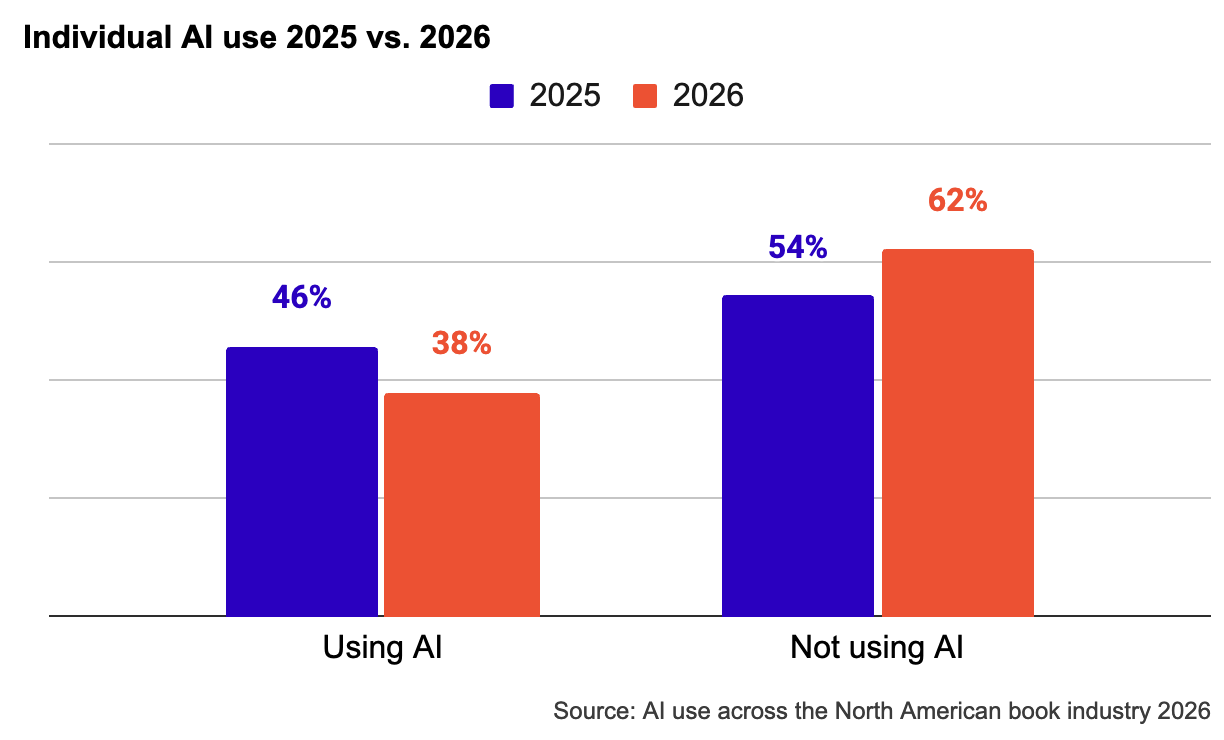
In the 2026 survey, 38% of respondents said they, as individuals, use AI. This is down 17% from 2025, marking a fairly significant decrease.
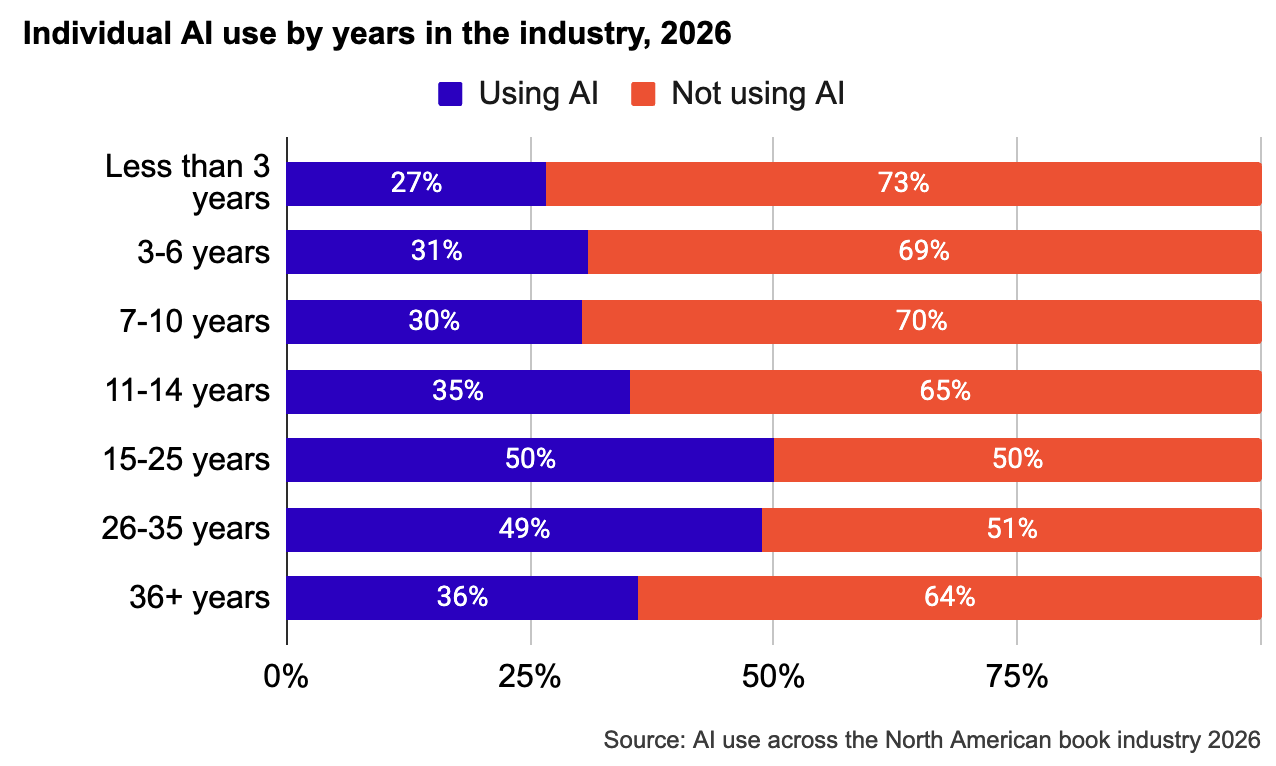
Find our source data here.
The likelihood of using AI as an individual generally increases with years of industry experience, peaking among those with 15–35 years in the industry before declining significantly among those with 36+ years of experience. Individuals with 15–20 years of experience in the industry were most likely to say they used AI as an individual (50%), followed by 25–35 years (49%). Individuals with less than three years of experience in the industry were least likely to say they used AI as an individual at 27%.
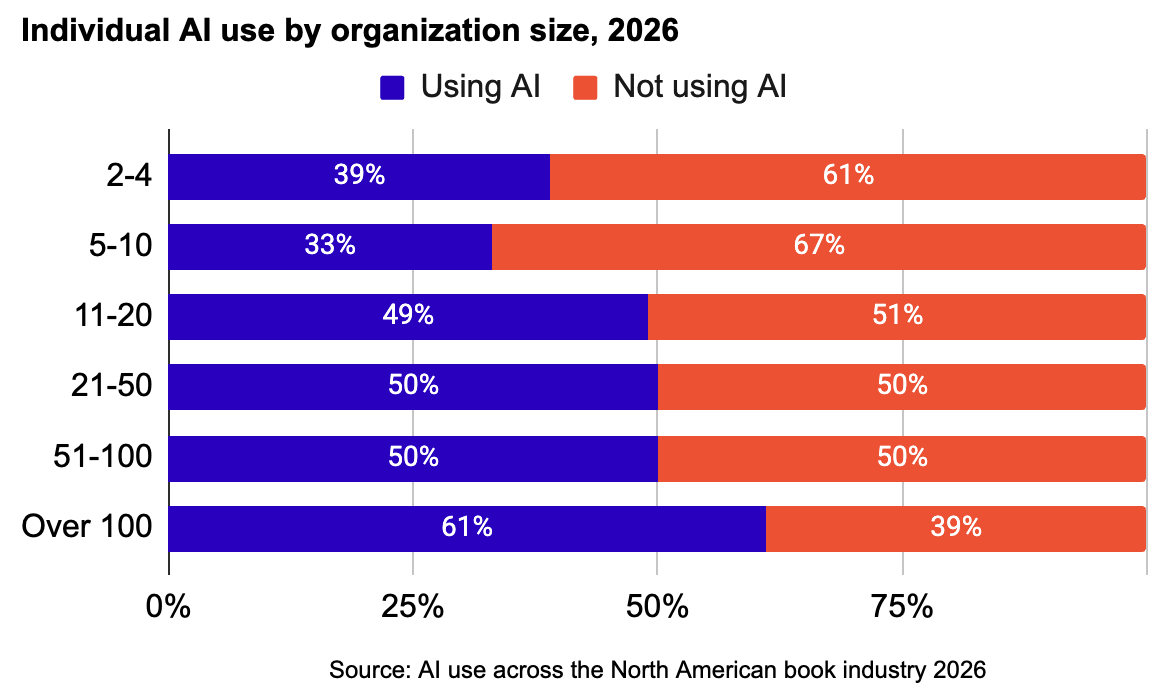
Find our source data here.
Individuals working at larger organizations were generally more likely to report using AI individually. The lowest rate of individual AI use was among respondents working at organizations with 5–10 employees (33%), while the highest was among those at organizations with 100+ employees (61%).
Approach to AI
Beyond the use of AI, the survey also examined how individuals are approaching AI in their work, including whether they are adopting, exploring, limiting, avoiding, or actively learning about AI. Overall, rather than actively incorporate AI into their workflows, respondents were more likely to focus on staying informed about the risks and impacts of AI or they chose not to use it. Approaches also varied considerably by experience, role, and employment context.
Respondents were asked how they are approaching AI in their work:
- 18%, the top answer, said they were “staying informed about disruptions/issues caused by or that involve AI in the industry” (18%). It was specified that this includes topics such as copyright infringement, quality assurance issues, and reader distrust.
- 13% said they were actively avoiding using AI.
- 12% said they were staying informed about new AI developments and potential applications.
- 12% said they were not currently using AI to support their work.
- 12% were not interested in using AI to support their work.
- 10% said they were actively discouraging others from using AI.
The least-selected responses were those related to actively using or exploring AI:
- 7% said they were exploring or experimenting with AI tools and applications.
- 6% said they were using AI in a very limited, controlled capacity.
- 5% of respondents said they were incorporating AI into existing structures or workflows or actively seeking or participating in AI training and professional development.
The number of years of industry experience was also associated with differences in how individuals approach AI. Respondents with more than 15 years of experience were twice as likely as those with fewer than 15 years to report seeking AI training, using AI, experimenting with AI, and staying informed about positive applications of AI. In contrast, respondents with fewer than 15 years of industry experience were twice as likely to report actively discouraging others from using AI. Both groups were equally likely to report staying informed about the potential negative uses or impacts of AI.
Among independent (self-employed) respondents, approaches to AI were fairly consistent. The data shows that the main groups to report using AI were self-publishers/author-publishers, editors, and consultants, although even within these groups, approximately twice as many respondents said they do not use AI. Those in a consulting role were most likely to indicate they were using AI, with 60% incorporating AI into their workflow and 47% saying they were using it in a controlled manner. A strong majority of authors (90%), illustrators (75%), translators (80%), designers (100%), and indexers (62%) reported avoiding use of AI in their work and were also more likely to actively discourage others from using it.
AI use among organizational leaders generally increases with the size of the organization. In this context, a leadership position refers to roles in which an individual oversees a group of people, makes decisions, and provides direction to their team members such as C-suite executives, directors, and owners/operators. Leaders at organizations with 2–20 employees reported experimenting with AI tools and developing their own approaches at rates ranging from 28% to 60%, compared with 60% to 89% among organizations with 21–100+ employees.
Formal AI training, however, remained relatively uncommon across all organization sizes, although it became more prevalent in larger organizations: among organizations with 100+ employees, 23% of leaders reported receiving formal AI training. Interestingly, leaders from organizations with 51–100 employees had the highest rate of AI experimentation at 89%, with no respondents in this group reporting that they were not using AI in their work.
Organizational AI use
This section examines how AI is being adopted and used at the organizational level, including how adoption varies by organization size and how awareness of AI use has changed over time. Compared with individual use, organizational adoption is more widespread, with larger organizations generally further along in incorporating AI into their work.
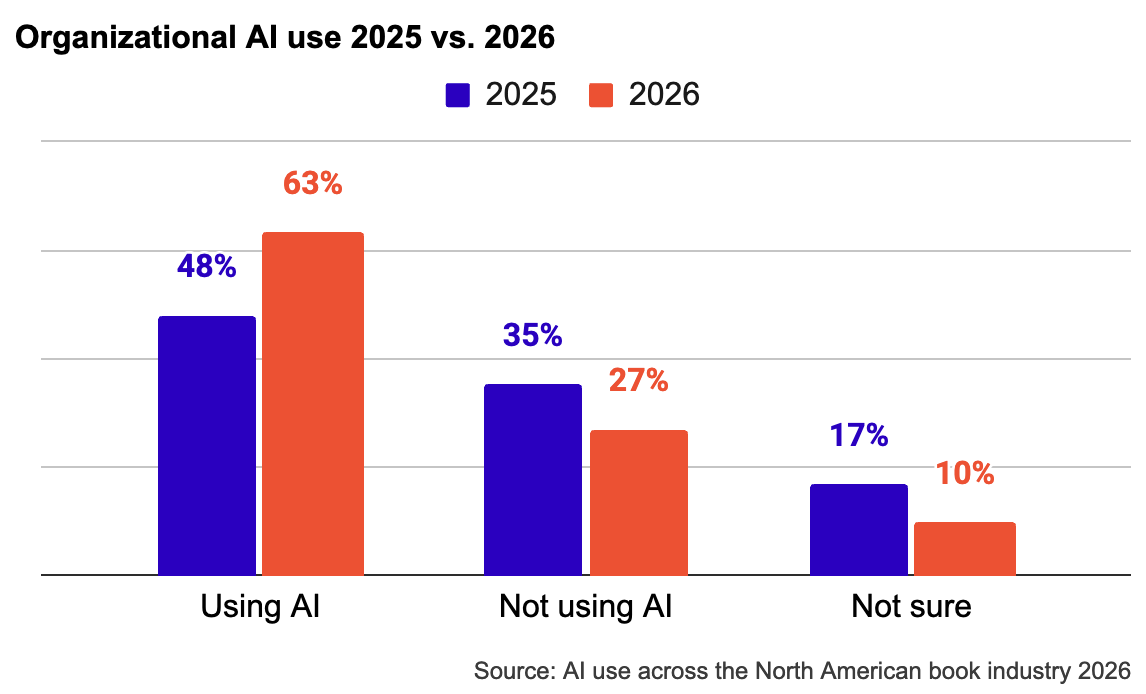
Find our source data here.
AI use has become much more widespread across organizations since 2025. In 2026, 63% of respondents said their organization is using AI, up from 48% in the previous year. Only 10% said they were unsure whether their organization was using AI, down from 17% in 2025. Together, these results point to both increased adoption and greater awareness of how AI is being used within organizations.
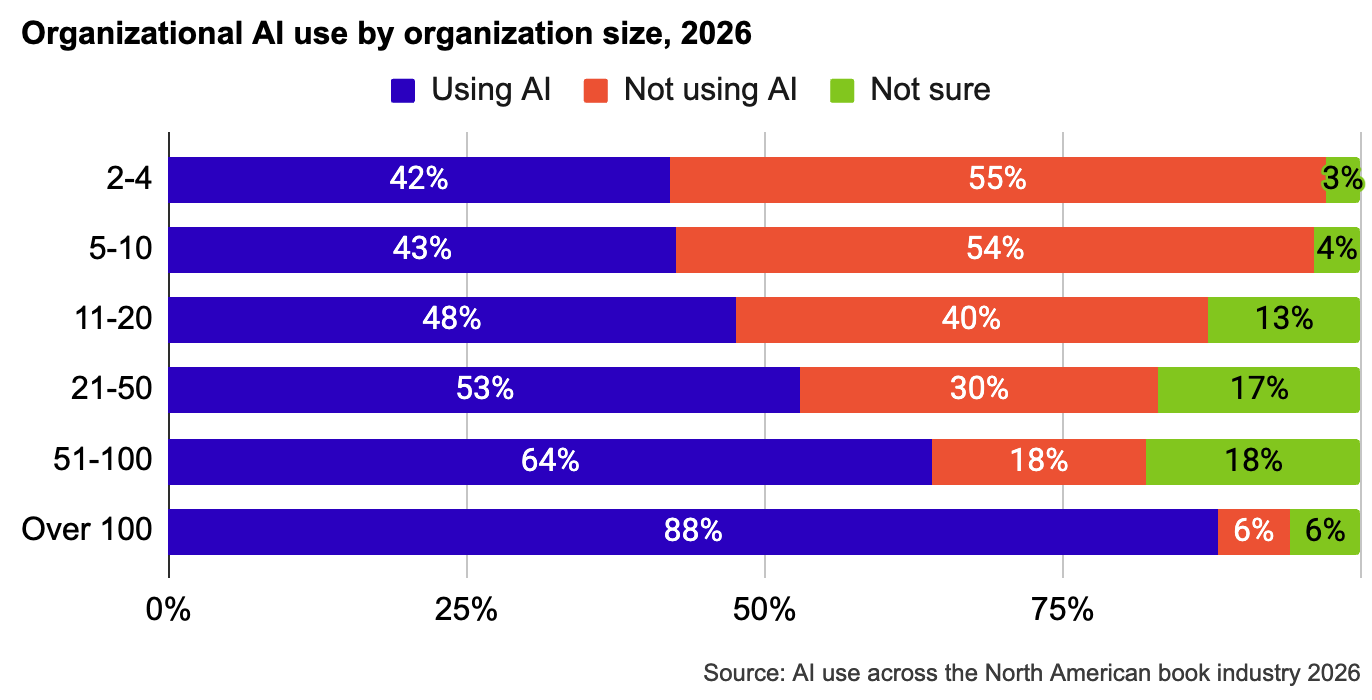
Find our source data here.
When looking at organization size, and organizational adoption of AI, the larger the organization, the more likely it is to be using AI. More than half of organizations with 21 or more employees reported using AI in their work. Adoption was highest among organizations with 100+ employees, where 88% reported using AI. This was 24% higher than the next-highest group, organizations with 15–100 employees, at 64%. Overall, the findings suggest that AI adoption is significantly more prevalent among larger organizations.
Approach to AI
This section examines how organizations are approaching AI, and the findings show that there is no single organizational approach, though there are trends associated with organizational size. While many organizations are moving toward controlled or exploratory use, others continue to discourage AI or leave decisions to individual departments.
Organizations are taking a range of approaches to AI, but most appear to be moving toward controlled adoption rather than unrestricted use. Organizations continue to take varied approaches to managing AI use.
- 27% of respondents said that their organization encourages the use of AI within controlled workflows and/or for specific tasks or departments.
- 22% said their organization is still in an exploratory phase and figuring out a definitive approach to AI.
- 10% said their organization is neutral and allows individual departments to decide whether to use AI.
When it came to discouraging AI:
- 16% said their organization discourages the use of AI.
- 8% reported that their organization encourages experimentation with no limitations on which AI tools can be used.
An organization’s approach to AI varies considerably by its size. Larger organizations were more likely to have structured approaches to AI:
- 38% of organizations with 51–100 employees encourage AI use within controlled workflows and/or for specific tasks or departments.
- 45% of organizations with 100+ employees encourage AI use within controlled workflows and/or for specific tasks or departments.
- 36% of organizations with 21–50 employees encourage experimentation without providing time or resources for learning and exploration.
In contrast, smaller organizations were more likely to discourage AI use:
- 42% of organizations with 2–4 employees discouraged AI use.
- 46% of organizations with 5–10 employees discouraged AI use.
Unrestricted experimentation was relatively uncommon overall, although it was most frequently reported among organizations with 51–100 employees (15%) and 100+ employees (8%).
AI adoption varies significantly by organization type as well:
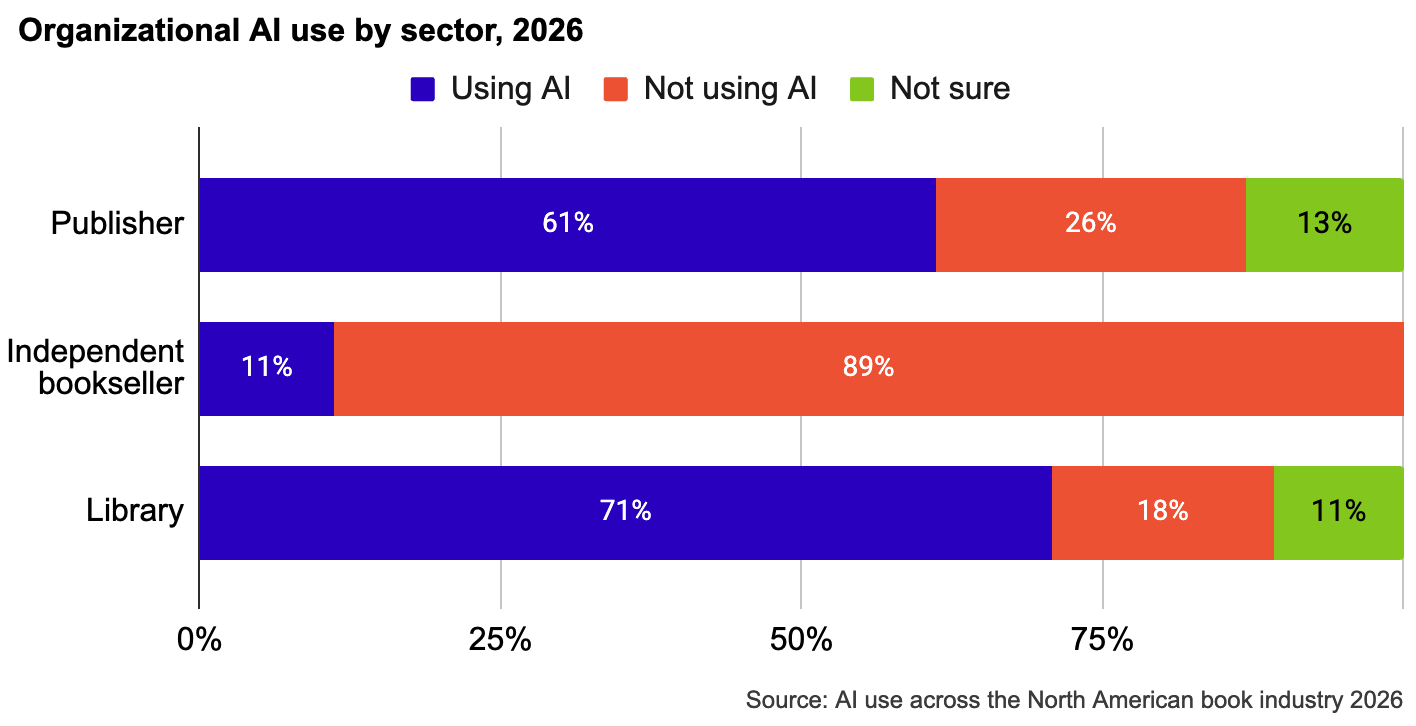
- A majority of publishers (61%) reported their organizations are using AI.
- Similarly 71% of libraries said they are using AI.
- All surveyed big-box retailers (100%) said they were using AI (though it should be noted there was a significantly lower sample size for this group, n=5).
- Independent retailers showed the lowest level of adoption, with 89% reporting that their organization does not use AI.
Overall, the findings suggest that AI adoption is more established among larger and institutional organizations, while independent retailers are considerably less likely to have adopted it.
AI use at the organizational level varied by sector with publishers (61%) and libraries (71%) much more likely to be using AI than independent booksellers (11%). All of the chain/big box retailers surveyed said they were using AI but this has been omitted from the graph data because the small sample size (n=5) does not necessarily provide an accurate reflection of industry attitudes.
Find our source data here.
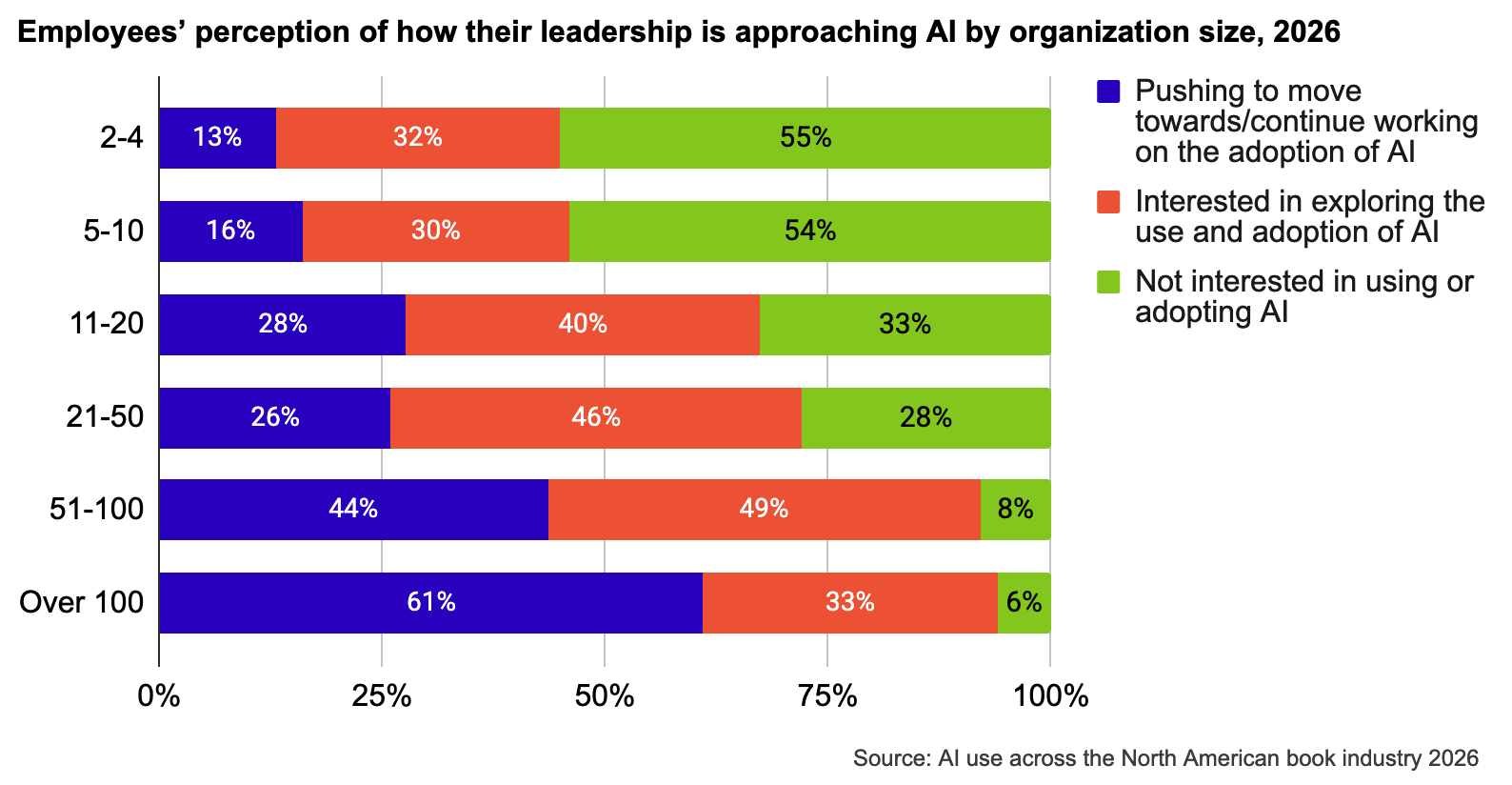
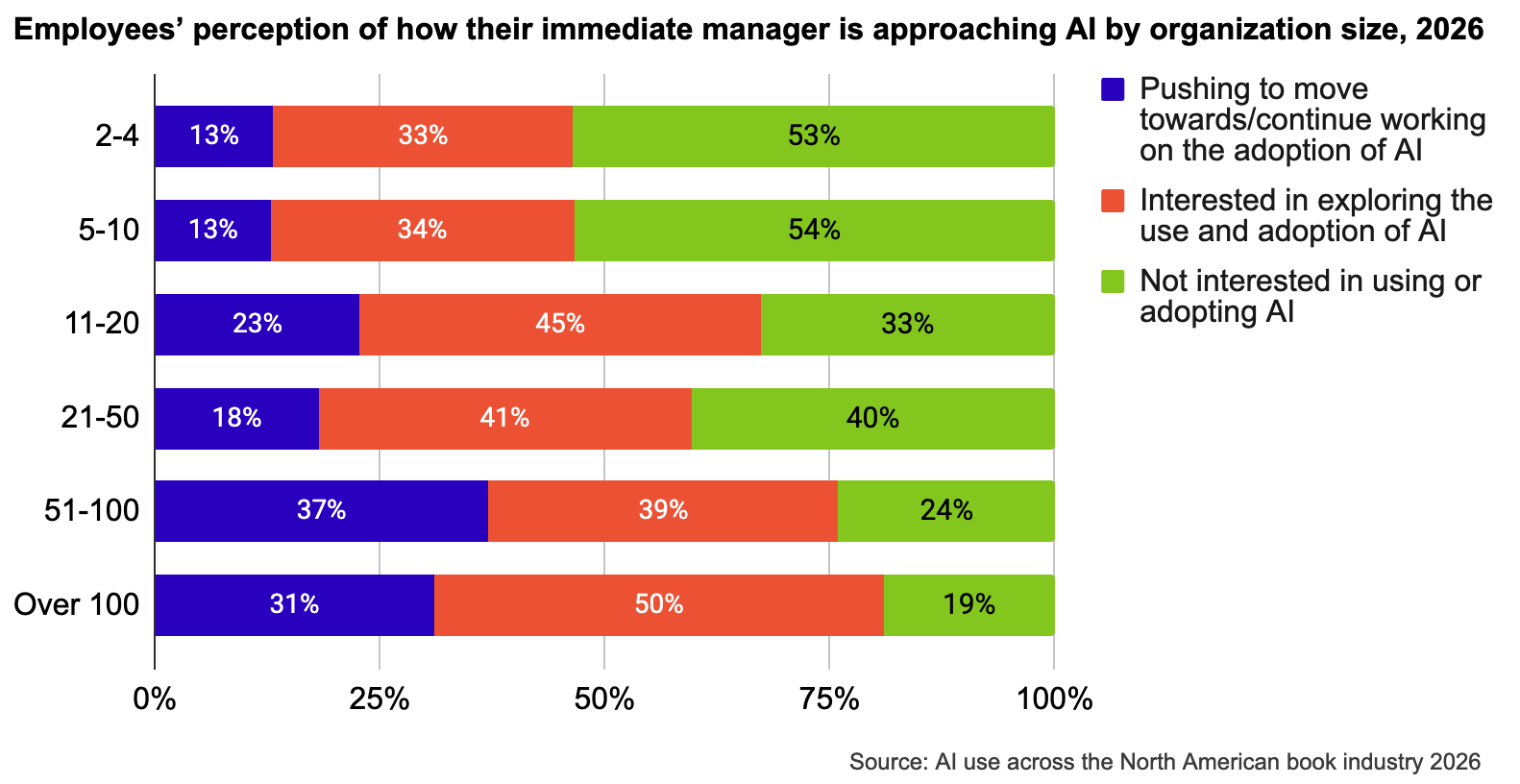
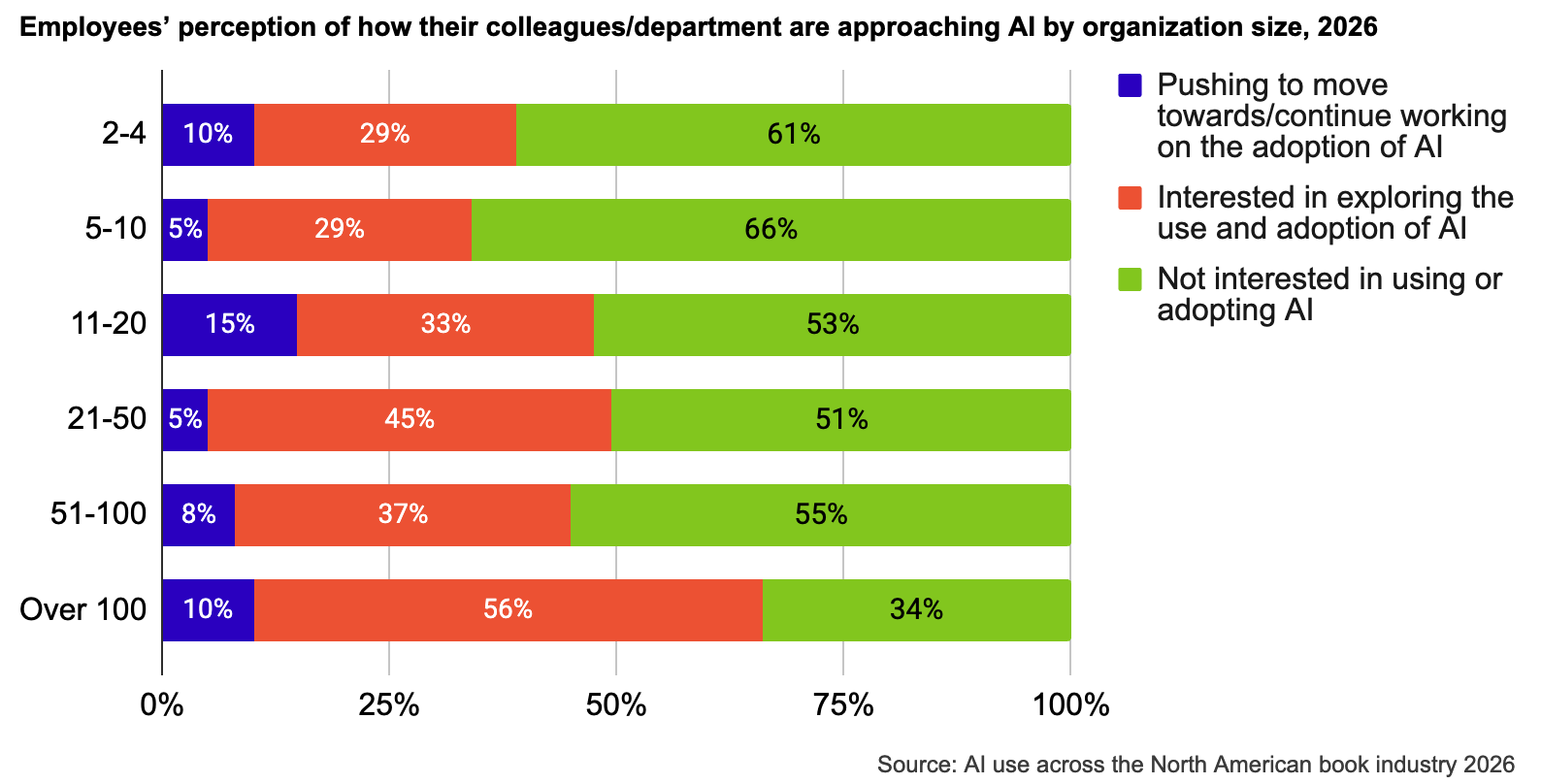
Respondents indicated their perception of AI adoption by their organization, manager, and colleagues.
- Respondents indicated that company leadership was most interested in exploring the use and adoption of AI (38%) or moving toward or continuing to work on AI adoption (37%).
- Their immediate managers were more likely to be described as interested in exploring the use and adoption of AI (43%) rather than pushing towards or continuing the use of existing AI (24%).
- At the respondents’ department level, their colleagues were not interested in using or adopting AI (49%), closely followed by interest in exploring the use of AI (43%), compared to only 8% who were pushing to work on existing AI.
The size of an organization also appears to influence how AI is approached across different levels of the organization.
Find our source data here.
At the leadership level, larger organizations were much more likely to be either pushing toward or continuing AI adoption, or interested in exploring it: these responses accounted for roughly 93% of organizations with 51+ employees, compared with about 70% of those with 11–50 employees and 45% of those with fewer than 10 employees.
Find our source data here.
Immediate managers showed a similar pattern of larger organizations having more interest in AI use, though the difference between organization sizes was smaller, ranging from 47% among organizations with 2–4 employees to 81% among those with 100+ employees.
Find our source data here.
The same trend appeared at the department level, with 34% of respondents in organizations with 5–10 employees reporting that their colleagues were interested in or pursuing AI, compared with 66% in organizations with 100+ employees.
Overall, as the analysis moves from organizational leadership to managers and then departments/colleagues, the gap in AI approaches between organization sizes narrows, and the average level of AI interest declines.
Organization size also impacted the results of how leaders support AI within their teams. Larger organizations were more likely to provide AI training:
- 33% of leaders at organizations with 100+ employees reported that they provide AI training.
- 4–11% of organizations with fewer than 10 employees provided AI training.
- 30–45% of organizations with more than 10 employees provided AI training.
Leaders at larger organizations were also more likely to support the use of existing AI tools, whereas only 28% of organizations with fewer than 10 employees reported doing so, compared with 45–55% of larger organizations. Few organizations of any size reported hiring staff or vendors specifically based on AI skills or to manage AI processes. Interestingly, efforts to incorporate AI into future goals and planning generally increased with organization size, although this trend dipped among organizations with 100+ employees.
Tools and environments
The findings for this section provide insight into not only whether AI is being used, but where and through what kinds of tools and environments. Results suggest that AI use takes place across a mix of enterprise, team, and personal environments, with privacy considerations also playing a role in how individuals access these tools.
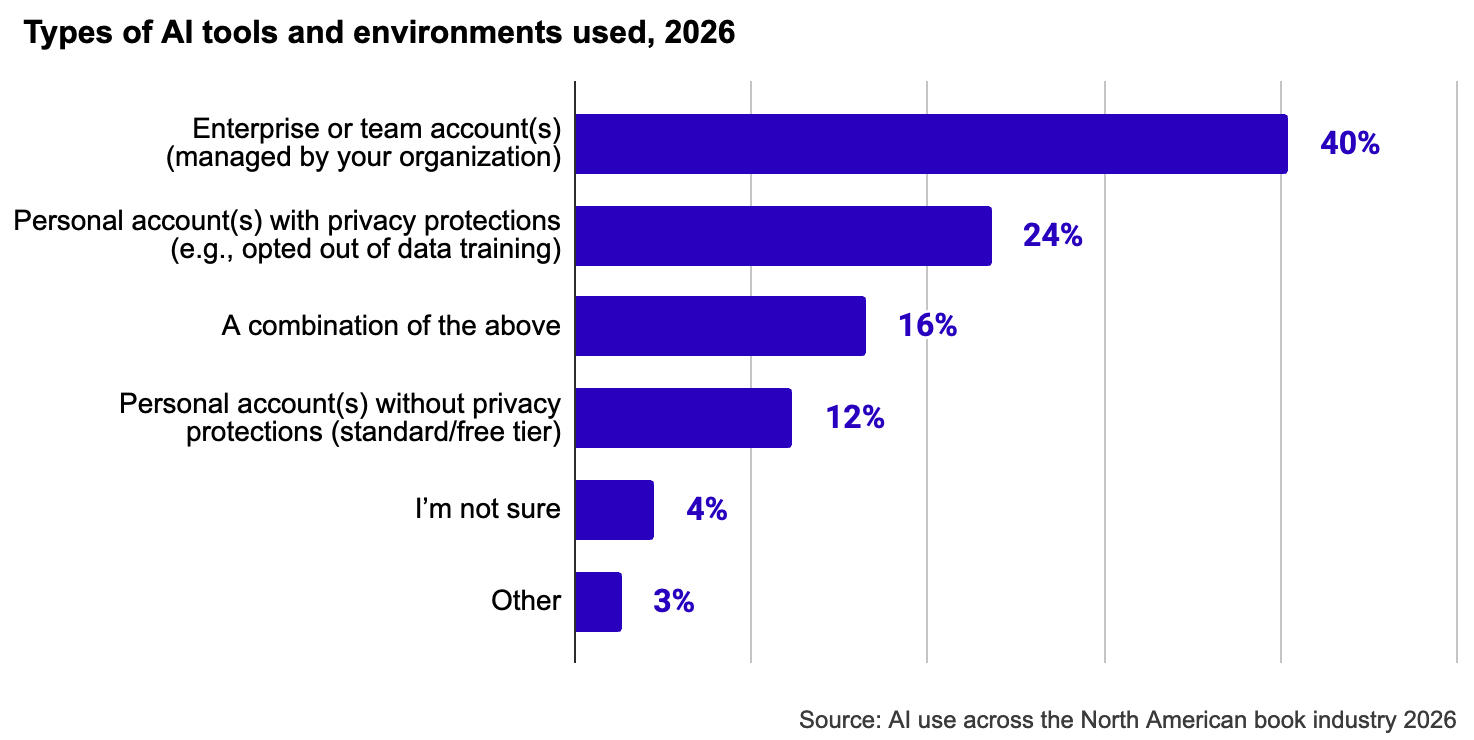
Find our source data here.
Among respondents who use AI professionally, enterprise and team accounts were the most common setup, with 40% reporting that they use them for their work. Another 24% use personal accounts with privacy protections, such as opting out of data training, while 12% use personal accounts without privacy protections, such as standard or free tiers. A further 16% use a combination of these account types.
The AI tools people use individually are largely the same as those being used at the organizational level, but at different rates. Among individuals, the most commonly used tools are:
- Standard versions of ChatGPT, Google Gemini, Anthropic Claude, Perplexity, and similar models (57%)
- Closed or enterprise AI models (48%)
- AI features built into existing software such as Google Workspace, Microsoft 365 Copilot, Adobe Creative Cloud, Canva, and Notion (47%)
- Generative AI tools to aid in tasks such as creating book covers, preparing marketing copy, preparing editorial feedback, and generating images and audio (25%)
At the organizational level, enterprise AI models and AI features within existing software were tied as the most common tools, both at 61%. Standard models were used by 41% of organizations, while 29% reported using generative AI tools. Overall, individuals appear more likely to use freely available AI models, while organizations show a stronger preference for enterprise tools and AI features integrated into existing software.
How AI is being used
Use cases refers to how AI is being used across the book industry, both by individuals and organizations, and how use varies by role, sector, and publisher type. The section also looks ahead to anticipated use, comparing organizations that are already using AI with those that have not yet adopted it. The findings show a consistent concentration of AI use in administrative, marketing, research, and data-related work.
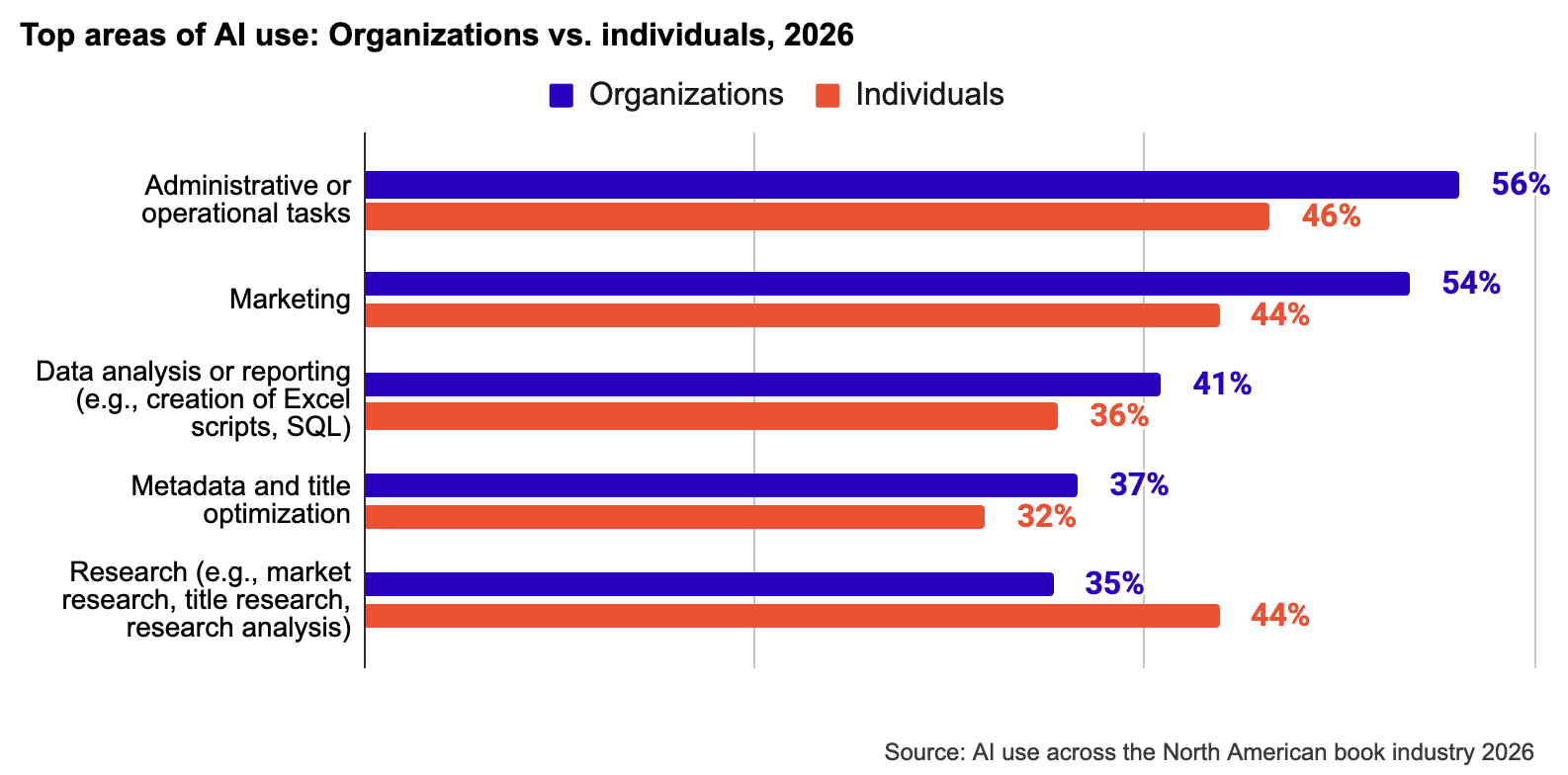
The areas in which individuals and organizations use AI the most are broadly aligned, although organizations generally report higher levels of use.
AI was most commonly used for:
- Administrative or operational tasks (individuals: 46% and organizations: 56%)
- Marketing (individuals: 44% and organizations: 54%)
AI was least used for:
- Rights and licensing management (individuals: 5% and organizations: 4%)
- QA testing (individuals: 5% and organizations: 6%)
Individuals are more likely than their organizations to use AI for research (44% vs. 35%), but organizations are more likely to use it for data analysis or reporting (41% vs. 36%) and metadata and title optimization (37% vs. 32%).
The ways independent individuals (those who are not employed by an organization) use AI varies depending on their area of work.
- Self-publishers and author-publishers reported the highest use of AI for marketing (73%), followed by research (50%), publicity (45%), and editorial work (41%).
- Editors primarily said they use AI for editorial work (63%), with marketing and research use reported at 50% respectively.
- Among consultants, research was the most common use of AI (62%), followed by marketing (54%) and data analysis (46%).
The category of organization an individual works for correlates to different use case patterns, although administrative and marketing-related tasks are common across the industry.
- Among individuals working for publishers, administrative tasks were the most common use (51%), followed by marketing, market research, and SEO, each at around 40%.
- Those working for manufacturers, including printers and paper suppliers, most commonly used AI for research and market research (75%), followed by administrative tasks (51%).
- Library employees most commonly used AI for learning and teaching (44%) and administrative tasks (41%).
- Service providers reported using AI for administrative tasks (68%), followed by data analysis and marketing (60% each).
- Trade publisher (n=66): Marketing (65%), metadata & title optimization (53%), and administrative/operational tasks (47%)
- Education publisher (n=10): Data analysis/reporting (80%), marketing (70%), and administrative/operational tasks (70%)
- Professional publisher (n=5): Administrative/operational tasks (100%), marketing (80%), editorial, manuscript evaluation, production, and accessibility (60% each)
- Research publisher (n=2): Manuscript evaluation (100%), data analysis/reporting (100%), administrative/operational tasks (100%), and code development/management (100%)
- University press (n=32): Administrative/operational tasks (47%), marketing (44%), and accessibility (44%)
- Non-profit/co-operative publisher (n=7): Administrative/operational tasks (86%), marketing (57%), and production (57%)
- Among organizations already using AI, 55% of respondents were unsure where they anticipated using it in the future.
- Among those who did identify potential uses, administrative or operational tasks were the most common (16%), followed by metadata, (15%) title optimization and research (15%), marketing (14%), data analysis (14%), and sales forecasting (14%).
- Of the organizations that are not currently using AI, 55% said they are not planning to use it at all. Among the remainder, anticipated use was spread relatively evenly across the same areas identified by organizations already using AI, at around 15% each.
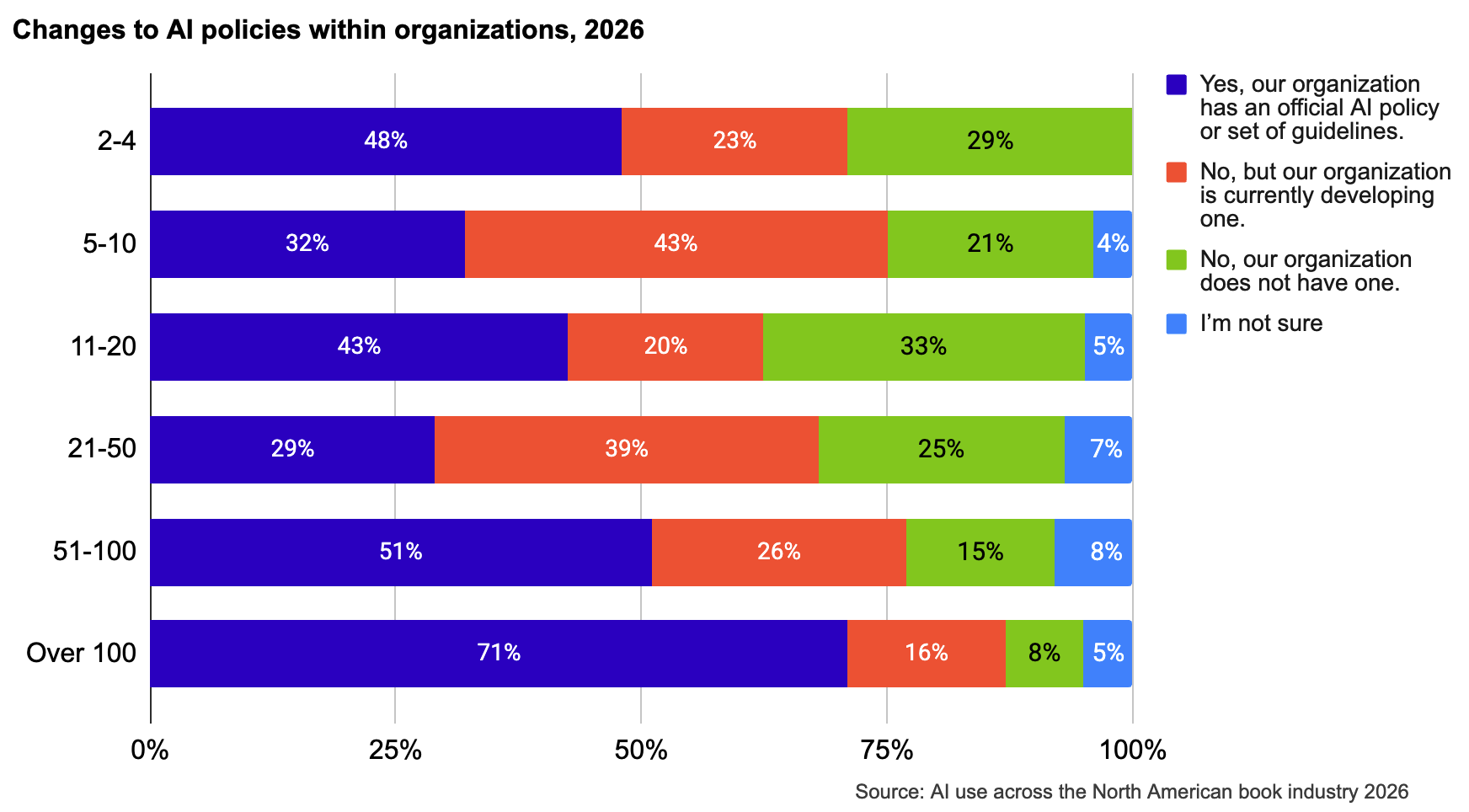
- Organizations with 2–4 employees: 48% have a policy and 23% are developing one.
- Organizations with 5–10 employees: 32% have a policy and 43% are developing one.
- Organizations with 11–20 employees: 43% have a policy and 20% are developing one.
- Organizations with 21–50 employees: 29% have a policy and 39% are developing one.
- Organizations with 51–100 employees: 51% have a policy and 26% are developing one.
- Organizations with 100+ employees: 71% have a policy and 16% are developing one.
- All surveyed organizations with 2–4 employees reported sharing the same AI approach or guidelines as their parent company.
- Alignment was also common among larger organizations: 28% of organizations with 21–50 employees and 39% of those with 51–100 employees said their approaches align with their parent company, compared with 17% and 35%, respectively, who said they do not.
- Among organizations with 100+ employees, 58% reported sharing their parent company’s approach and just 4% said they did not.
- In organizations with 5–10 employees, 39% said their approach does not align, compared with 34% who said it does.
- In organizations with 11–20 employees, 38% reported that their approaches differ and 32% reported alignment.
- 58% of organizations with 2–4 employees
- 41% of organizations with 5–10 employees
- 40% of organizations with 11–20 employees
- 32% of organizations with 21–50 employees
- 33% of organizations with 51–100 employees
- 40% of organizations with 100+ employees
- 86% were concerned about copyright (e.g., inadequate controls around the use of copyrighted material, uncertainty about whether AI-generated material can be copyrighted)
- 80% were concerned about job loss or negative impacts on creators (authors, illustrators, etc.)
- 79% were concerned about negative impacts on the environment and/or the organization’s sustainability goals or reporting
- 78% were concerned about legal liability (e.g., copyright infringement, data privacy breaches)
- 89% were concerned about AI-generated books, including fraudulent or low-quality content, flooding major retail platforms (e.g., Amazon)
- 89% were concerned about the accuracy of AI information when using the tools (false positives from AI detectors, AI hallucinations)
- 86% were concerned about the accuracy of AI for consumers (inability to distinguish between AI-generated, AI-assisted, and human-generated works, inaccurate book information generated by an AI tool)
- 85% were concerned about author and creator care, including the protection of their intellectual property
- Completing tasks faster than a human could in areas such as data cleanup, code troubleshooting, creation of meeting summaries and task lists, etc.
- Using AI summaries to triage content. For example, rather than reading a full report or transcript from a webinar, the user will generate an AI summary which they will use to decide whether or not the source material is worth their time.
- Doing targeted research, by refining results better than a regular search engine.
- Quickly repurposing content for marketing.
- Learning and professional development/career development
- Email management — Not to be confused with email marketing, this includes filtering and searching through emails to help with prioritization, follow-ups, creating calendar tasks, etc.
- Accessibility — This includes creating or improving alt text, remediating digital books, and similar tasks.
- Legal work — For example, creating a draft or final version of a contract. Some respondents mentioned that creating a first draft and sending it to their lawyers for approval saves them money.
- “AI has helped identify BISACs in a more expeditious manner than sifting through the BISAC list.” (University Press, Department: Production, Role: Director of Editorial, Design, and Production)
- “I also like having conversations with AI about the work I’m doing. This means I ask it questions about developmental editing and editing in general and we discuss ways I can represent myself on LinkedIn or my website. It saves me time on many things by quickly answering questions and offering ideas.” (Independent, Role: Editor)
- “I have used AI to increase my productivity in virtually every way. Since mid-2024, I’ve been actively using AI every single day, and have developed deep systems and tooling for my work, which spans Editorial, Software Engineering, Marketing, Management, Strategy, and personal productivity. I primarily use Claude Code and Codex to build and maintain the active and passive AI systems that support my work and the work of my team.” (Trade Publisher)
- “I only use AI to create scripts (excel macros, python scripts, etc.) to automate processes. These were fairly obscure manual tasks I was doing by hand before such as pulling the schema.org metadata out of an EPUB file and converting it to ONIX codes to be added to a publisher’s ONIX database or removing badly-encoded characters and replacing them with the proper characters from a database export. This has significantly improved the speed at which I can do these tasks. However, it means that while I used AI to CREATE the tool, AI itself is not part of the ongoing workflow and no real data has been fed into the AI systems.” (Independent)
- “I use AI primarily to assist with research and writing, specifically editing, brainstorming, and wordsmithing my writing for reports. I would say it streamlines the research process and makes my writing and editing quicker because I find myself getting stuck less.” (Library)
- “I use AI to help create regular expressions for text substitutions, sometimes to help develop macros, and for miscellaneous tech support (e.g., figuring out how to format something correctly in Word when I’m unable to figure out how to do so myself). I also develop indexing utilities and make use of autocomplete in Visual Studio Code, along with some prompting. In none of these cases does the AI have contact with a book or an index, and I carefully review and test all AI-generated code/regular expressions/macros to ensure it meets my standards. I generally find this speeds up my work in the short term at the expense of learning in the long term, so I have been moving away from it.” (Independent, Role: Indexer)
- “In ebook production, AI primarily helped me improve the quality of image descriptions. I asked an LLM to generate an initial description, then incorporated useful ideas or wording into my own version. In this case the benefit was more in quality than efficiency. In software development to support business operations, AI has been writing more of the code as time progresses. For a given project I ask it to generate code incrementally, and I review the results after each round before we move on. In several cases, this has allowed me to complete projects hours sooner than if I had written all the code myself. Examples include adding Thema subjects to our ONIX feed, updating our ONIX codelists to the latest issue, and automating the daily validation of our ONIX feed.” (Trade Publisher, Department: Production, Role: Senior Production Developer)
- “Research into legal and technical concepts is often much more efficient when done with AI.” (Education Publisher)
- “The clearest efficiency win I’ve seen is in building business and author websites. What used to take months now takes a week or two with Claude, including getting the site live and handling basic SEO setup. I also use AI for administrative and organizational tasks — generating folder structures and file-naming conventions for multistep editing projects, building spreadsheet templates to track images across photo-heavy manuscripts like cookbooks, and writing custom Word macros and wildcards that save hours of repetitive formatting work on every project going forward. But outside of cases like these, I honestly don’t think AI saves me time or makes me more efficient, and I want to be careful not to overstate its impact. That doesn’t mean it isn’t useful; it just means efficiency isn’t the only lens worth applying. Human beings aren’t machines, and our worth isn’t measured by our output. If anything, working alongside AI has sharpened my appreciation for human cognition and judgment, and for the fact that good judgment simply takes time. That’s not a cost to be optimized away. It’s the work.” (Independent, Role: Editor)
- “Use AI to create assembly sheets, do castoffs for manuscripts on different design templates, analysis of data in Biblio database, cost forecasting, rate comparisons between vendors, normalizing freelancer rates for copyediting and proofreading, optimizing scheduling, help writing complicated emails and tone check, creating reports, building powerpoint slides, creating rate cards comparison among vendors with decision tree pathways based on variables, projected quoting for projects, assessment of languages extant in manuscripts, gathering knowledge about trends and products in publishing, information analysis, references for Chicago Manual of Style (with citations to source sections to avoid hallucinations), inquiries about publishing best practices and competing presses, BUT WE NEVER put manuscripts into AI or use AI to generate manuscript material, and NEVER use AI to copyedit, proof, or index.” (University Press, Department: EDP (Combination of editorial, design, and production), Interim EDP Manager)
- “We are a very small publishing company. Most of us have other jobs. AI allows us to get more done, look professional, and maybe come close to competing with other publishing companies. We use it to create contracts for lawyers to review (which saves us money). We use it to write sales emails (which saves us time). We use it to write media releases (which save us even more time). I often use it for providing reports to my team as AI not only thinks of things I have missed, but it also presents the information in a clear and understandable way…. Often we plug information into ChatGPT and ask it to form it into whatever we need (report, email, contract, etc.). We also ask it to ask us additional questions to get better results. We’ve named her Gertie and see her as the administrative staff we can’t afford to hire right now.” (Trade Publisher, Role: Project Manager – Co-Owner)
- Time spent on AI-related fixes or tasks: This includes time spent correcting mistakes, refining prompts, reviewing outputs, redoing the work of an AI, or learning how to safeguard data and privacy.
- Adding more work or extra steps: For example, using AI to edit the tone of written material but then having to review it and edit for length or clarity.
- Robotic writing tone: AI’s automated or robotic tone that does not read as authentic or credible.
- Learning curve: Some respondents mentioned that the time it takes to learn how to use a tool effectively or safely defeats the potential benefits that may come from its use. They also mentioned getting discouraged by this.
- False information: This includes hallucinations or saying that there is no information available about a subject when that is not the case.
- The difficulty of opting out of certain AI features (for example in MS Office)
- The saturation of AI and the feeling of being bombarded by AI that is everywhere
- AI becoming an obstacle when AI-embedded tools interrupt or alter familiar processes
- Writing-related tasks, such as drafting, proofreading, and editing.
- Marketing tasks, including email marketing and the creation of blurbs or other marketing copy.
- Research, which can include searching for general or more specialized information.
- Metadata, such as BISAC selection or enhancement for backlist titles.
- Translation of emails or communications in foreign languages.
- Administrative tasks, including task management and optimization.
- Content creation, such as voice-overs for training videos.
- Accessibility, including creation of alt text in InDesign.
- “AI consistently makes so many mistakes or misses so many opportunities for better optimization that I feel that I spend as much/more time correcting mistakes and filling gaps as I would if I were doing the work of optimization without the “help” of an AI tool. For example, we recently used an AI to help optimize the data of a publisher of theatrical texts. The tool was quick to apply the BISAC DRA038100 for immigration and emigration to titles where it was not applicable at all, but failed to add it to titles where it was applicable. Also, the tool could not tell the difference between a play by an American playwright about a European subject and a work of European fiction, or a play that is nominally set in, for example, New Jersey, and a play ABOUT New Jersey.” (Distributor)
- “Keyword iteration is a long process requiring highly specific prompting, with dubious outputs. Like humans, AI can’t understand the nuances of a text without reading the entire thing, and I can’t upload a manuscript to a service that will train its model on that input. Our company ethically opposes supporting AI financially.” (Marketing Agency)
- “We are spending a lot of time discussing and experimenting with what AI COULD do instead of just getting the work done ourselves. I had to uncover and undo work a colleague did with AI because it was inaccurate and would have been an embarrassment if shared publicly.” (Trade Publisher)
- “While AI has done a lot to help me organize some workflows and take things off my plate in some ways, the learning curve in order to implement and figure it out has required a great deal of time, so the time I’ve saved I have sacrificed in the learning of how to use it. In the future, I feel the balance may tip, but for now it has not really made me more efficient or productive. Just differently busy.” (Role: author, editor, coach, sensitivity read, and typesetter.)
- The Canadian Book Market 2025 (Paid) is our annual comprehensive report on the Canadian market. Contains detailed information on more than 50 subject categories, including market share, weekly unit sales, average selling price, top 10 hardcover and paperback sellers, and public library lending information.
- Canadian Leisure & Reading Study 2025 looks at how Canadians are spending their leisure time and the behaviours of Canadian readers in 2025.
- Canadian Book Consumer Study 2025 compiles the results from our biannual surveying of Canadians about their book buying and reading habits in 2025.
- United States
- Canada
- Female
- Male
- Non-binary
- I belong to an organization.
- I am self-employed.
- Publisher
- Literary agency
- Manufacturer (printer or paper)
- Distributor
- Wholesaler
- Independent bookseller
- Chain/Big box retailer
- Library
- Service provider (software company, vendor, etc.)
- Industry organization/association
- Other (please specify)
- Editorial
- Design
- Production
- Marketing
- Publicity
- Sales
- Rights
- Other (please specify)
- Trade publisher
- Education publisher (K–12 and higher education)
- Professional publisher
- Research publisher
- University press
- Non-profit or co-operative publisher
- Author (working with trade publishers)
- Self-publisher or author-publisher
- Illustrator
- Editor
- Translator
- Designer
- Sensitivity reader
- Indexer
- Consultant
- Other (please specify)
- Less than 3 years
- 3–6 years
- 7–10 years
- 11–14 years
- 15–25 years
- 26–35 years
- 36+ years
- Less than 3 years
- 3–6 years
- 7–10 years
- 11–14 years
- 15–25 years
- 26–35 years
- 36+ years
- 2-4
- 5-10
- 11-20
- 21-50
- 51-100
- Over 100
- Yes
- No
- Actively seeking or participating in AI training and/or professional development
- Incorporating AI into my existing structures or workflows
- Using AI in a very limited, controlled capacity
- Experimenting with AI tools and approaches
- Staying informed about new AI developments and potential applications
- Staying informed about disruptions/issues caused by or that involve AI in the industry (e.g., copyright infringement, QA issues, reader distrust)
- Not currently using AI to support my work
- Not interested in using AI to support my work
- Actively avoiding the use of AI
- Actively discouraging others from using AI
- AI training is relevant to my current role, and I actively seek it out.
- AI training is relevant to my current role, but I haven’t made it a priority yet.
- AI training is not relevant to my current role, but I expect that to change.
- AI training is not relevant to my current role, and I don’t anticipate that changing.
- I have ethical objections to AI training, even though it’s relevant to (or required in) my work.
- I have ethical objections to AI training, and it isn’t relevant to my work anyway.
- Enterprise or team account(s) (managed by your organization)
- Personal account(s) with privacy protections (e.g., opted out of data training)
- Personal account(s) without privacy protections (standard/free tier)
- A combination of the above
- I’m not sure
- Other (please specify)
- Open AI models (e.g., Standard (sometimes free) service provided by ChatGPT, Google Gemini, Anthropic Claude, Perplexity)
- Closed or enterprise AI models (e.g., Enterprise versions of ChatGPT, Gemini, Claude, or Perplexity)
- Generative AI tools (e.g., for creating book covers, marketing copy, editorial feedback, image or audio generation)
- AI tools for vibecoding (e.g., for the creation of applications by guiding AI assistants through natural language prompts)
- Using agentic AI (e.g., for executing complex, multi-step processes/workflows)
- Predictive AI tools (e.g., for sales forecasting, demand planning, inventory management)
- Writing- and publishing-specific AI tools (e.g., Shimmr, Storywise, Sudowrite, Jasper, Veristage Insight, Writer, Grammarly Business)
- Audiobook production AI tools (e.g., ElevenLabs, Kova)
- AI features within existing software (e.g., Google Workspace, Microsoft 365 Copilot, Adobe Creative Cloud Firefly, Canva Magic Studio, Notion AI)
- Custom in-house or proprietary AI tools
- I’m not sure
- Other (please specify)
- Editorial (e.g., content editing, copyediting, developmental editing)
- Manuscript evaluation (e.g., use of AI detectors)
- Marketing (e.g., copywriting, campaign planning, audience targeting, content creation, brainstorming)
- Publicity (e.g., media outreach, press materials, influencer engagement)
- Production (e.g., layout, design, typesetting, file preparation)
- Accessibility (e.g., alt text creation)
- Sales forecasting and market analysis
- Rights and licensing management
- Metadata and title optimization (e.g., keywords, BISAC and Thema codes, ONIX files)
- Customer service or reader engagement
- Data analysis or reporting (e.g., creation of Excel scripts, SQL)
- Administrative or operational tasks (e.g., scheduling, meeting notes, email management, slides creation)
- Research (e.g., market research, title research, research analysis)
- Code development or management for digital products
- Translating book content into other languages
- Creating AI-narrated audiobooks
- QA testing
- Educational (e.g., library staff learning and teaching patrons how to use AI)
- Using AI as an assistant to identify potential additions or changes to an originally human-created metadata record
- Using AI to create all the metadata records of frontlist titles
- Using AI to optimize the metadata records of backlist titles
- Using AI only to help with BISAC and/or Thema subject code classification
- Other (please specify)
- Yes
- No
- Yes
- No
- I’m not sure
- My organization encourages experimentation and has no limitations on how or which AI tools can be used.
- My organization encourages the use of AI within controlled workflows and/or for specific tasks or departments.
- My organization encourages experimentation, but does not offer time or resources for learning and exploration.
- My organization encourages the use of AI, but it sets a limit to machine learning models only (systems that learn from controlled data sets to improve performance), not generative AI (e.g., ChatGPT, Claude, etc.).
- My organization is in an exploratory phase, figuring out a definitive approach to AI.
- My organization is neutral on AI and allows each department to decide whether they want to use it or not.
- My organization discourages the use of AI.
- To my knowledge, my organization has not taken a position on the use of AI yet.
- I’m not sure.
- Yes, our organization has an official AI policy or set of guidelines.
- No, our organization does not have one.
- No, but our organization is currently developing one.
- I’m not sure.
- Yes, we share the same guidelines and/or policies.
- Yes, we share the same approach, but there are no guidelines or policies in place.
- No, we have different approaches.
- I’m not familiar with the approach our parent company has towards AI.
- I’m not sure.
- Not applicable.
- My organization is implementing strategies to safeguard the IP of our creators.
- My organization is working on establishing workflows to safeguard the IP of our creators.
- My organization has no concrete plan to safeguard the IP of our creators yet.
- My organization is leaving it up to creators to implement strategies to safeguard their IP.
- I don’t know.
- Editorial (e.g., content editing, copyediting, developmental editing)
- Manuscript evaluation (e.g., use of AI detectors)
- Marketing (e.g., copywriting, campaign planning, audience targeting, content creation, brainstorming)
- Publicity (e.g., media outreach, press materials, influencer engagement)
- Production (e.g., layout, design, typesetting, file preparation)
- Accessibility (e.g., alt text creation)
- Sales forecasting and market analysis
- Rights and licensing management
- Metadata and title optimization (e.g., keywords, BISAC and Thema codes, ONIX files)
- Customer service or reader engagement
- Data analysis or reporting (e.g., creation of Excel scripts, SQL)
- Administrative or operational tasks (e.g., scheduling, meeting notes, email management, slides creation)
- Research (e.g., market research, title research, research analysis)
- Code development or management for digital products
- Translating book content into other languages
- Creating AI-voiced audiobooks
- QA testing
- Educational (e.g., library staff learning and teaching patrons how to use AI)
- I’m not sure
- Editorial (e.g., content editing, copyediting, developmental editing)
- Manuscript evaluation (e.g., use of AI detectors)
- Marketing (e.g., copywriting, campaign planning, audience targeting, content creation, brainstorming)
- Publicity (e.g., media outreach, press materials, influencer engagement)
- Production (e.g., layout, design, typesetting, file preparation)
- Accessibility (e.g., alt text creation)
- Sales forecasting and market analysis
- Rights and licensing management
- Metadata and title optimization (e.g., keywords, BISAC and Thema codes, ONIX files)
- Customer service or reader engagement
- Data analysis or reporting (e.g., creation of Excel scripts, SQL)
- Administrative or operational tasks (e.g., scheduling, meeting notes, email management, slides creation)
- Research (e.g., market research, title research, research analysis)
- Code development or management for digital products
- Translating book content into other languages
- Creating AI-voiced audiobooks
- QA testing
- Educational (e.g., library staff learning and teaching patrons how to use AI)
- I’m not sure
- Editorial (e.g., content editing, copyediting, developmental editing)
- Manuscript evaluation (e.g., use of AI detectors)
- Marketing (e.g., copywriting, campaign planning, audience targeting, content creation, brainstorming)
- Publicity (e.g., media outreach, press materials, influencer engagement)
- Production (e.g., layout, design, typesetting, file preparation)
- Accessibility (e.g., alt text creation)
- Sales forecasting and market analysis
- Rights and licensing management
- Metadata and title optimization (e.g., keywords, BISAC and Thema codes, ONIX files)
- Customer service or reader engagement
- Data analysis or reporting (e.g., creation of Excel scripts, SQL)
- Administrative or operational tasks (e.g., scheduling, meeting notes, email management, slides creation)
- Research (e.g., market research, title research, research analysis)
- Code development or management for digital products
- Translating book content into other languages
- Creating AI-voiced audiobooks
- QA testing
- Educational (e.g., library staff learning and teaching patrons how to use AI)
- No, we’re not planning on using AI at all
- Open AI models (e.g., Standard (sometimes free) service provided by ChatGPT, Google Gemini, Anthropic Claude, Perplexity)
- Closed or enterprise AI models (e.g., Enterprise versions of ChatGPT, Gemini, Claude, or Perplexity)
- Generative AI tools (e.g., for creating book covers, marketing copy, editorial feedback, image or audio generation)
- AI tools for vibecoding (e.g., for the creation of applications by guiding AI assistants through natural language prompts)
- Using agentic AI (e.g., for executing complex, multi-step processes/workflows)
- Predictive AI tools (e.g., for sales forecasting, demand planning, inventory management)
- Writing- and publishing-specific AI tools (e.g., Shimmr, Storywise, Sudowrite, Jasper, Veristage Insight, Writer, Grammarly Business)
- Audiobook production AI tools (e.g., ElevenLabs, Kova)
- AI features within existing software (e.g., Google Workspace, Microsoft 365 Copilot, Adobe Creative Cloud Firefly, Canva Magic Studio, Notion AI)
- Custom in-house or proprietary AI tools
- Not sure
- Other (please specify)
- Yes
- No
- I’m not sure
- Accessibility
- AI policy development
- Author management and acquisitions
- Audiobook production and narration
- Customer service
- Design
- Disclosure of the use of AI tools in the creation of books, including the differentiation of AI-generated vs. AI-assisted works
- Distribution and transportation
- Ebook production
- Editorial
- Ethics
- Laws and regulations (e.g., transparency requirements, copyright)
- Licensing content to third-party AI companies (for training or product development)
- Management of contracts, rights, and royalties
- Manufacturing
- Metadata creation and optimization to aid with book discovery
- Metadata creation and optimization to communicate whether AI was used in the creation of a title (e.g, generated or assisted the writing, audiobook narration, translation)
- Sales and marketing, including forecasting
- Sustainability and environmental reporting
- Translation
- Vendor and procurement evaluation
- I’m not sure
- Other (please specify)
- Accessibility
- AI policy development
- Collections management
- Data privacy and security
- Digital literacy and community education
- Laws and regulations (e.g., transparency requirements, copyright)
- Patron services
- Vendor and procurement evaluation
- I’m not sure
- Other (please specify)
- Accessibility
- AI policy development
- Customer service
- Data privacy and security
- Sales and marketing
- Vendor and procurement evaluation (e.g., Assessing POS systems with AI features)
- I’m not sure
- Other (please specify)
- My organization has developed new policies or guidelines in favour of the use of AI.
- My organization has developed new policies or guidelines to establish limitations or guardrails around the use of AI.
- My organization has developed new policies or guidelines against the use of AI.
- My organization hasn’t changed its approach to AI over the past year.
- Manuscript evaluation
- Editorial
- Management of contracts, rights, and royalties
- Other (please specify)
- Yes
- No
- I am experimenting with AI tools and approaches on my own.
- I am working on my AI literacy.
- I am seeking peer learning opportunities from other members of my organization.
- I am getting formal training on AI.
- I am not using or planning on using AI in my work.
- Other (please specify)
- Hiring new staff with AI skills or experience
- Providing AI training for existing staff
- Supporting the use of AI tools within existing platforms (e.g., Google, Microsoft, Canva)
- Hiring consultants or vendors to manage AI processes
- Encouraging experimentation among my team
- Including AI in future strategic planning
- Incorporating AI-related goals into employee objectives
- Developing—or supporting the development—of AI guidelines and policies
- Leading or participating in AI-focused initiatives
- Discouraging the use of AI and/or educating others on how to opt out
- My team does not use and is not planning to use AI
- Other (please specify)
- I see AI as a time-saving/efficiency tool.
- I see AI as a cost-saving tool.
- I see AI as a threat to my work and the organization/team I lead.
- I see AI as a waste of time.
- I’m concerned about my organization being perceived as being behind due to our lack of adoption of AI.
- Engaging my employees in the adoption of AI has been challenging.
- Enforcing our guidelines against the use of AI has been difficult.
- I find it difficult to handle the imbalance between employees who are in favour and against the use of AI.
- None of these statements apply.
- Copyright (e.g., inadequate controls around the use of copyrighted material, uncertainty about whether AI-generated material can be copyrighted)
- Legal liability (e.g., copyright infringement, data privacy breaches)
- Job loss or negative impacts on publishing career pathways
- Job loss or negative impacts on creators (authors, illustrators, etc.)
- Negative impact on book publishing employees’ mental health (e.g., compromising on ethics and values, fear to put the company and/or creators’ IP at risk unknowingly, fear for the future of the industry)
- Security risks or increased exposure to cyberattacks
- Lack of understanding of how AI technologies work, the risks that come with using AI tools, and the potential ways to mitigate them
- Difficulty keeping pace with rapid changes in AI technologies compared to competitors and/or other industries
- Negative impacts on the environment and/or the organization’s sustainability goals or reporting
- Too expensive for smaller organizations, giving organizations with bigger budgets an unfair advantage
- Reputation damage and/or fear of stigma from using AI
- Other (please specify what risk-related concern you have)
- Concerns about the accuracy of AI information when using the tools (false positives from AI detectors, AI hallucinations)
- Inaccurate, false, or biased training data used by AI systems that reinforces or amplifies discrimination and oppression
- Incorrect or misleading content that hinders accessibility (e.g., links to inaccessible content)
- Concerns about the accuracy of AI for consumers (inability to distinguish between AI-generated, AI-assisted, and human-generated works, inaccurate book information generated by an AI tool)
- AI-generated books, including fraudulent or low-quality content, flooding major retail platforms (e.g., Amazon)
- Lack of disclosure to consumers when AI-generated content is used
- Author and creator care, including the protection of their intellectual property
- Lack of trust in the companies developing and controlling AI technologies, including vendors not disclosing when AI is running in the background
- Not applicable – I currently have no trust-related concerns or pain points
- Other (please specify what trust-related concern you have)
- You may use my comments and include my role and department.
- You may use my comments, but without including my role and department.
- Please do not use my comments in any public materials.
Overall, administrative work and marketing are prominent AI use cases across all organization types, while roles connected to sales and business development show stronger use of AI for data analysis and research.
When examining the types of publishers using AI and how they are leveraging it, several key trends emerged. However the sample sizes differed greatly with some groups having relatively small sample sizes. Sample sizes by segment have been included below to provide better context.
Overall, administrative tasks and marketing were the most consistently reported uses of AI across publisher types, while other applications varied more depending on the type of publisher.
The top areas where organizations and individuals are using AI are administrative tasks, marketing, data analysis, metadata and title optimization, and research. This suggests that AI is being used primarily to streamline routine, information-intensive tasks.
Find our source data here.
When comparing organizations that are already using AI and those that are not currently using it, we see notably different expectations for future adoption.
Policies and governance
This section looks at how organizations are developing and managing policies and governance around AI. The findings suggest that organization size plays an important role in how AI governance develops, with larger organizations being generally more likely to have formal policies, and align their approach with a parent organization. Additionally, this section looks at what areas these policies address and how organizations are responding to the need to protect creator IP.
Find our source data here.
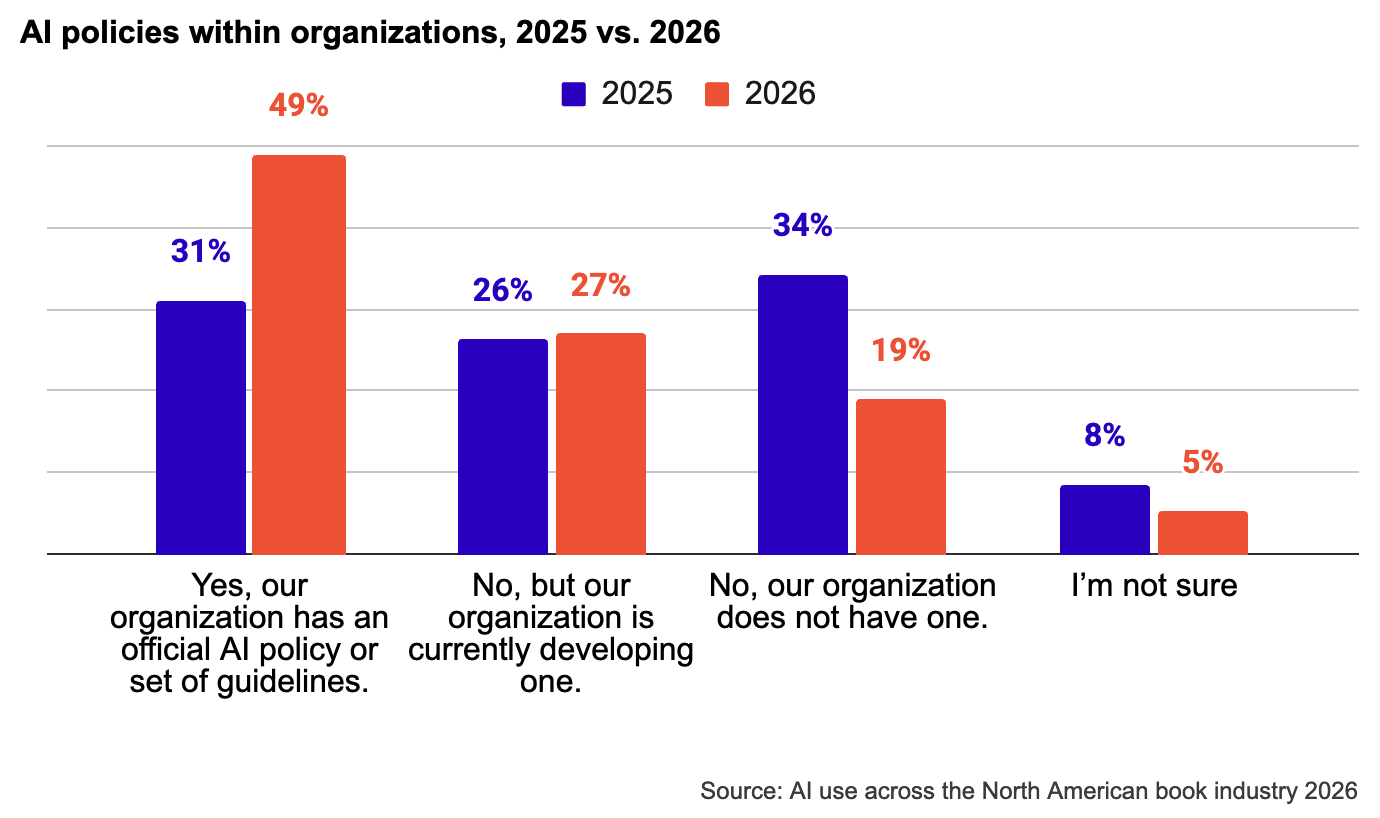
In 2026 49% of respondents said their organization has an AI policy or guidelines, up from 31% in 2025.
Find our source data here.
The likelihood of having an official AI policy or set of guidelines generally increases with organization size:
Overall, it appears that the larger the organization, the more likely to have formalized their approach to AI, while smaller organizations are more likely to still be developing their policies.
The survey looked at an organization’s AI approach compared to that of its parent company.
Small to mid-sized organizations were more likely to not have alignment between their approach and their parent companies.
Overall, the data suggests that the largest organizations are considerably more likely to have an AI approach that aligns with their parent company.
Find our source data here.
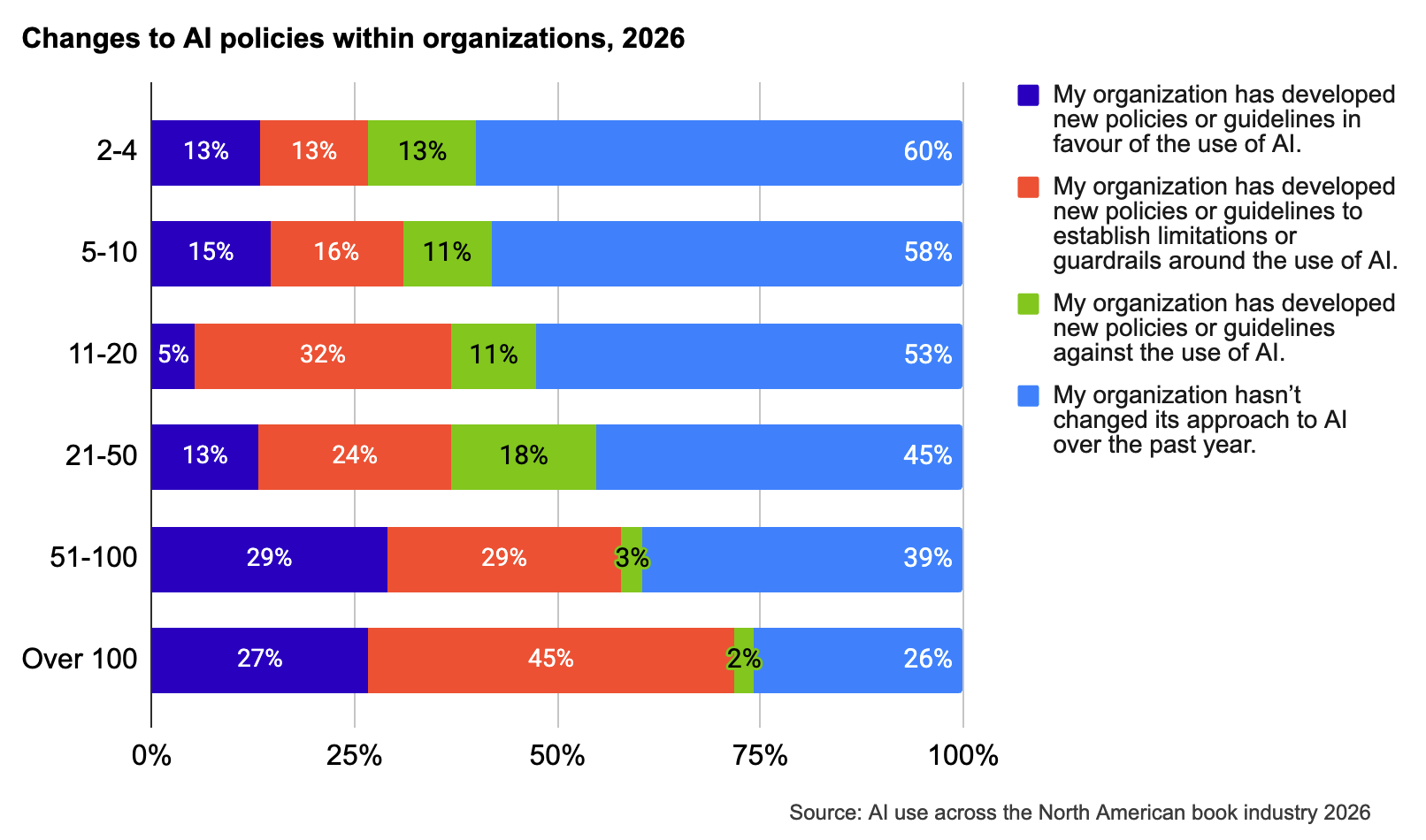
The survey asked respondents if their organizations changed their AI policies in the last year. Larger organizations were significantly more likely to have changed their AI policies or AI guidelines over the past year. The percentage of those reporting a change rose steadily with organization size, from 40% among organizations with 2–4 employees to 74% among those with 100+ employees. The nature of these changes also differed by organization size. Organizations with 50 or more employees almost exclusively reported changes intended to support the use of AI, either by encouraging adoption or establishing limitations and guardrails around its use. In contrast, organizations with fewer than 50 employees were more likely to have developed new policies that discourage or restrict the use of AI.
Changes to AI-related policies most commonly covered editorial work (54%), manuscript evaluation (27%), and management of contracts, rights, and royalties (23%). An additional 48% said changes to AI policy were made in other areas.
When it comes to intellectual property (IP) protection the most common response was that organizations are already implementing strategies to safeguard creator IP (39%). Another 16% are working on establishing workflows to do so, while 12% have no concrete plan yet. In 9% of cases, organizations are leaving the responsibility to individual creators to implement their own strategies. Nearly one-quarter of respondents (24%) said they did not know what their organization was doing to safeguard creator IP, suggesting that awareness and communication around these strategies remains a notable gap.
Smaller organizations were generally more likely to report that they are already implementing strategies to safeguard the intellectual property of their creators, though larger organizations were only marginally lower:
Organizations with 11–20 employees were the most likely to report having no concrete plans to safeguard creator IP (18%), while respondents at organizations with 100+ employees were most likely to say they did not know what their organization was doing (34%). Overall, smaller organizations appear slightly more likely to report active IP protection efforts.
Education, training, and best practices
Perspectives on AI training and professional development reveal a mix of interest, uncertainty, and ethical concerns across the industry. Priorities when it comes to education, training, and best practices differ by type of organization, with publishers, libraries, and retailers each placing emphasis on a different set of areas. Together, these findings point to the need for sector-specific guidance.
Education and training
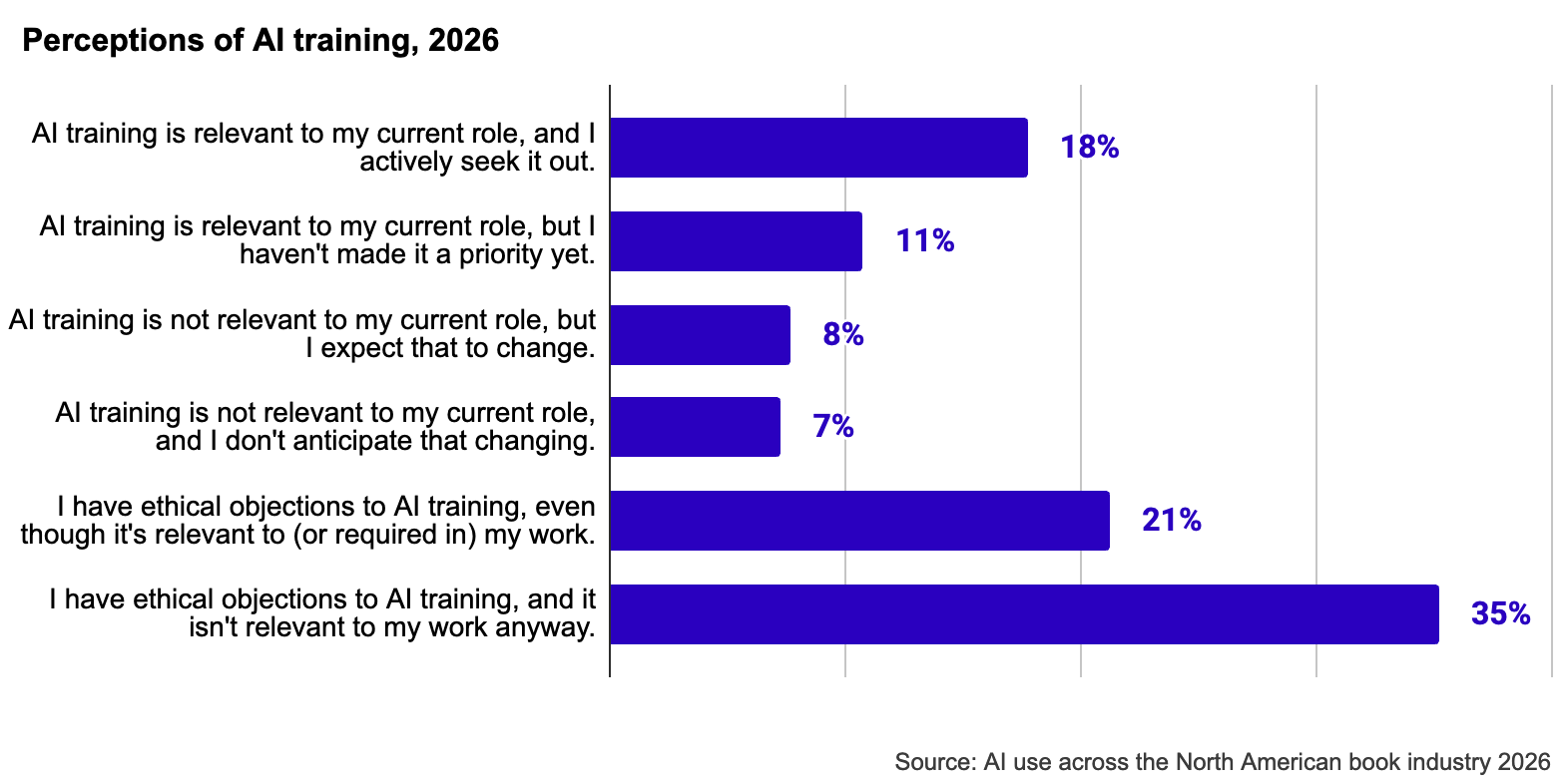
Find our source data here.
When looking at AI training and professional development, ethical concerns were the most common reason for not pursuing training. More than one-third of respondents (35%) said they have ethical objections to AI training and that it is not relevant to their work, while another 21% have ethical objections even though AI training is relevant to or required in their work. In contrast, 18% said AI training is relevant to their current role and that they actively seek it out, while 11% said it is relevant but they have not yet made it a priority. A smaller group said AI training is not currently relevant but expect that to change (8%), while 7% do not expect it to become relevant to their role.
Best practices needs
Across the industry, AI policy development, legal and regulatory guidance, and data privacy and security emerged as recurring areas where organizations said they would benefit from best practices and guidelines. However the top areas varied slightly depending on type of organization.
The top areas where publishers said best practices and guidelines on AI would be helpful were laws and regulations, including transparency requirements and copyright (63%); disclosure of AI use in the creation of books, including distinguishing between AI-generated and AI-assisted works (63%); and AI policy development (61%).
For libraries, the top areas were collections management (76%); digital literacy and community education and AI policy development (71% each); data privacy and security (67%); and laws and regulations and accessibility (63% each).
For independent booksellers, the top areas were AI policy development (67%) and data privacy and security (67%).
Top concerns and barriers to use
This section examines the top AI concerns and barriers to use, including perceived risks, trust in AI technologies and the companies developing them, and concerns about their broader impact on the book industry. The findings show that respondents are not only concerned with how AI works, but also with what its adoption could mean for creators, workers, consumers, organizations, and the environment. While copyright remains an important concern, the 2026 results show increased attention to issues such as job impacts, creator protection, security, sustainability, accuracy, transparency, and trust.
The 2026 results show some notable shifts in perceptions of the risks associated with AI. Concerns about copyright stayed the same (86% in both 2025 and 2026), while concerns about legal liability saw an 7% increase. Concerns about potential job loss also grew substantially, increasing by 17% for publishing career pathways and 16% for creators. Security risks rose by 14%, while concerns about the environmental and sustainability impacts of AI saw the largest increase, rising by 44% from 2025. Concerns about cost remained relatively stable, decreasing by 1%.
The new 2026 questions also highlight additional areas of concern, including the mental health impacts of AI (61%), lack of understanding of AI risks and risk-mitigation strategies (59%), and reputational damage or stigma associated with AI use (48%).
Top risk concerns:
Overall, the results suggest that while copyright remains an important concern, respondents in 2026 are increasingly focused on AI’s broader impacts on jobs, creators, security, sustainability, and the people working in the industry.
Trust-related concerns remained high in 2026, with several areas showing notable changes from 2025. Concerns about the accuracy of AI information increased from 84% in 2025 to 89% in 2026. Similarly, concerns about AI-generated books flooding retail platforms rose from 81% to 89%, while concerns about a lack of disclosure to consumers increased from 74% to 82%. The largest increase among comparable measures was author and creator care, including protection of intellectual property, which rose from 44% to 85% (a 94% year-over-year increase). Concerns about a lack of trust in companies developing and controlling AI technologies also increased from 74% to 81%. Concerns about inaccurate, false, or biased training data rose from 84% to 88%.
Concerns about incorrect or misleading content affecting accessibility decreased slightly from 61% to 58%. A new question in 2026 also found that 86% of respondents were concerned about the accuracy of AI for consumers, including the difficulty of distinguishing between AI-generated, AI-assisted, and human-generated works.
Top trust concerns:
Perceptions
This section brings together respondents’ broader reflections on AI, such as respondents’ perceptions of AI’s impact on their work efficiency, as well as how they believe the industry should respond to the technology’s continued development. These questions provide space for respondents to consider the larger role AI should, or should not, play in the future of publishing.
Impact of AI on efficiency
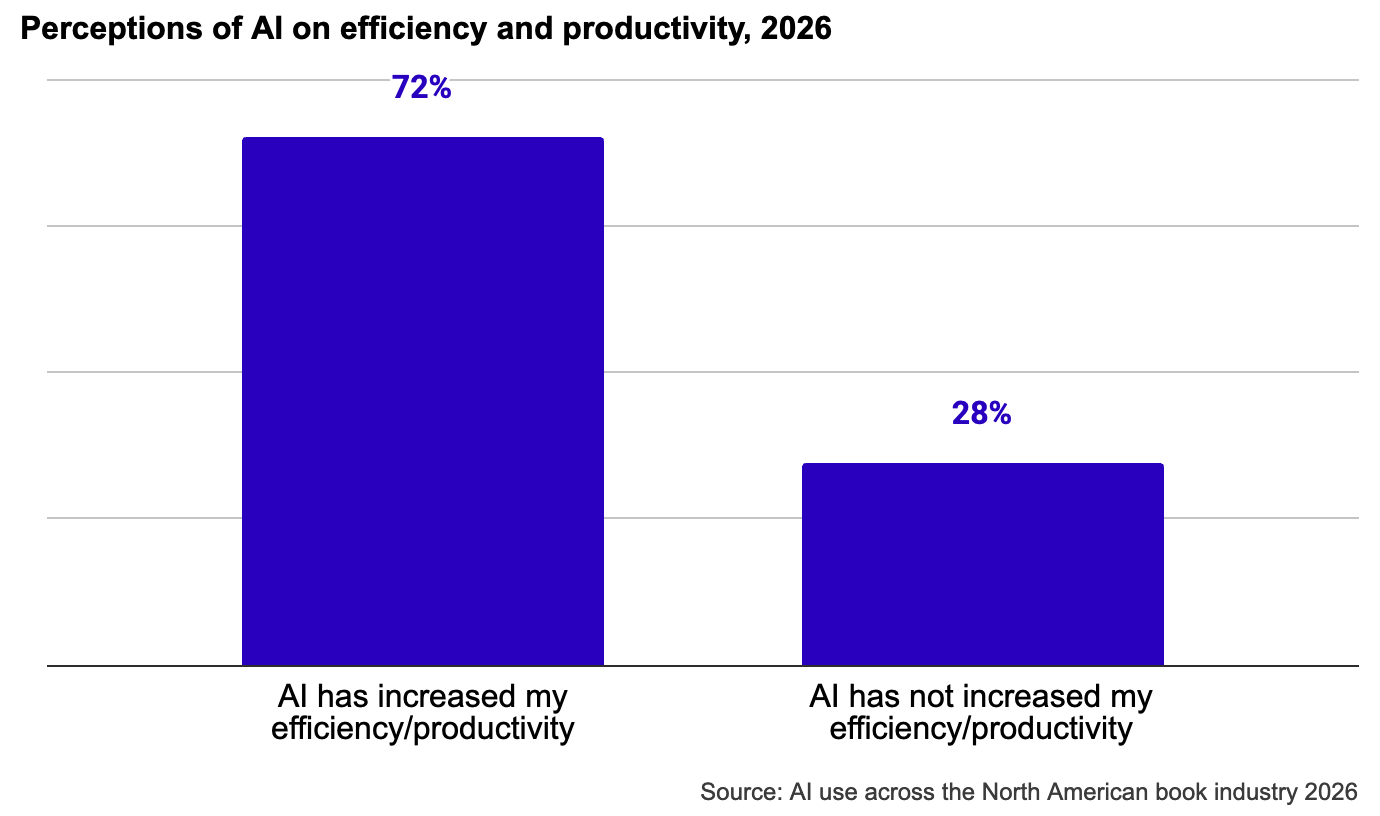
Find our source data here.
Most respondents reported that AI has had a positive impact on their productivity, with 72% saying that AI has increased their efficiency and/or productivity. However, more than one-quarter (28%) said it has not. Overall, the results suggest that while AI is providing perceived productivity benefits for many respondents, its impact is not universal.
Efficiency improved by AI
We asked survey respondents who said they are using AI and who believe it is making them more efficient and productive to provide examples of use cases and share as much detail as possible about how they approach AI. We received around 150 responses. There were no subject prompts or required talking points. Highlights are divided by awareness of limitations, user goals, and the use cases.
Awareness of AI limitations
One theme that arose from the open-ended responses was the ways users worked around the limitations of AI. Several respondents mentioned that they ensure there is human oversight when using AI. They do this either by making sure a human reviews the work of the AI, doing the tasks themselves and then using AI for only inspiration or searches, or focussing on ways human and machine collaboration is possible. Some respondents also mentioned being mindful of the potential for hallucinations and inaccuracies. A smaller group mentioned setting strict rules about what content is shared with an AI tool to ensure privacy and safety.
Goals of AI use
Some respondents also made implicit or explicit mention of the goal of using AI and how it relates to boosting efficiency and productivity. There were five main areas that emerged:
Time-saver: Most respondents said they were using AI to save time.
Thinking partner: Respondents mentioned that they use AI as a thinking partner. This included using AI to provide feedback on their own work, preparing for media interviews, presentations, and reports, asking the AI to ask questions about the material and identify gaps, using AI to figure out where to start when approaching a complex, confusing, or overwhelming task, as well as general brainstorming.
Consolidating: Many respondents said they use AI to create summaries or key highlights from long material such as reports. This also included taking data sets and turning them into actionable and clear information that can be used for themselves or their team.
Increased capacity: Respondents shared that AI often allows them to increase their capacity and do things that otherwise wouldn’t be possible, whether due to reduced staff, budget, or time.
Methods and tools: Respondents talked about using AI for automation, with some referencing tools that they created for themselves using AI, as well as using agentic AI. For specific tools that respondents are using, please refer to the “Tools and environments” section of the report.
AI use cases
Respondents shared the following use cases in which they perceive AI to have increased their efficiency or productivity. The following examples are listed from most to least cited.
Writing-related tasks: This encompasses anything from drafting, proofreading, and copyediting to creating citations and adjusting the tone for clarity or for a particular audience.
Research: This includes market research, research for writing, editorial, and indexing purposes, research from vetted knowledge bases, research for professional development, and fact-checking. Interestingly, a small group of respondents discussed using AI to fact-check results given by other AIs. Other use cases include researching general questions (where to have an external meeting in a specific city, how far is place A from place B, etc.) or searching for books to recommend to library patrons.
Administrative work: This includes analyzing meeting transcripts and minutes, creating and assigning tasks based on their content, creating summaries, and keeping track of daily tasks. Other administrative tasks in which respondents are using AI are related to accounting such as bookkeeping and expense tracking, as well as creating and analyzing profit-and-loss statements.
Marketing: Primary areas mentioned were social media marketing, planning events, and content marketing. Respondents also said they are using AI for review analysis and tracking of social media and sales trends.
Processes: Broadly, this category refers to streamlining, improving, or creating processes and workflows.
Technical work: Anything from coding and creating spreadsheet scripts to troubleshooting complex technical issues that would normally require help from an expert, as well as tasks related to software development.
Data: Data analysis, data processing, and data management, including automated creation of reports followed by their analysis and summaries.
Metadata: This includes using AI for creating or improving metadata records, including the selection of BISAC and Thema codes, and the improvement and updating of ONIX records.
Other less frequently referenced areas where respondents said they use AI were
The following are direct quotes from respondents on how AI was improving their productivity:
Efficiency not improved by AI
We asked respondents who said they’re using AI, but who don’t believe it’s making them more efficient or productive to provide examples of use cases and share as much detail as possible about how they approach AI. We received about 50 responses. There were no subject prompts or required talking points. Key highlights are outlined below.
Ineffectiveness was the main barrier to efficiency and productivity. This encompasses the use of AI leading to unsatisfactory outcomes, such as AI tools providing information that is vague or not helpful. For example, one respondent mentioned how ineffective an AI tool was at suggesting which BISAC codes to select for a title. Another cited example is AI acting only as an echo chamber instead of giving meaningful feedback. Respondents also shared that they found some AI tools incapable of following parameters or industry best practices. They also mentioned AI tools asking too many questions before completing a task.
Other barriers to efficiency that were often mentioned were:
Additional, less frequently cited issues and barriers include:
Use cases
Respondents mentioned the following use cases in which they perceive AI to have failed at increasing their efficiency or productivity:
The following are direct quotes from respondents on how AI was not improving their productivity:
Approaching AI as an industry
Respondents were asked about how the industry as a whole should approach AI and the results show a strong preference for caution and awareness over broad AI adoption in the book industry. While 33% agreed or strongly agreed that the industry should adapt to new technologies, including the careful adoption of AI, a larger 79% agreed or strongly agreed that the industry should stay informed about AI’s evolution without necessarily moving toward implementation or adoption. Views were more divided on limiting AI use to areas that do not touch creators’ work, with 46% agreeing or strongly agreeing and 31% disagreeing or strongly disagreeing. The strongest opposition to AI adoption emerged in response to the statement that the book industry should not get involved with AI because it conflicts with its role in protecting and ethically sharing human creative work: 57% agreed or strongly agreed, compared with 26% who disagreed or strongly disagreed. Overall, respondents appear to favour staying informed about AI while remaining cautious about its implementation, particularly where it intersects with human creative work.
Open-ended responses analysis
Respondents were asked if there was anything else they’d like to share about the role of AI in the book industry or their experiences with these technologies.
Analysis of these open-ended responses revealed the same conclusions as the majority of the survey data. Across both independents and employees (people working for an organization), AI sentiment is predominantly negative. The strongest shared concerns are copyright and the ethics of training data, environmental impacts, threats to creative and publishing jobs, declining quality and trust, and the pressure to adopt AI before its risks and benefits are well understood. Both groups distinguish between AI that might assist with administrative or analytical work and generative AI replacing human creative or editorial labour.
Responses from employees
Employees also lean negative (57%), but their responses reveal more tension between personal concerns and workplace realities. Key themes include pressure from management to adopt AI, fear of job displacement and deskilling, and frustration with tools that create more work than they save. At the same time, some employees see potential for AI to support administrative tasks and overburdened teams, provided there is meaningful human involvement.
“There is a constant, low-level pressure for us to use AI for everything possible…. It’s exhausting and makes me feel devalued.” (Trade Publisher)
“We are being asked to make time to learn AI and where it can help us be more efficient, but we are already struggling so much with our workload that it’s hard to find the time to do this. I can think of a lot of areas AI might help us, and has as a whole, but it feels like we might be dreaming bigger than we need to when there are other ways we could solve our issues through better tooling in general and not just try and throw everything at AI.” (Ebook Retailer)
“I think there is some value to implementing AI in the administrative side; my department is overworked and I’m interested in the ways it may be able to reduce our grunt work. However, I would never use AI in any part of creative editorial work.” (Trade Publisher, Department: Finance, Role: Accounting Associate)
“I’ve gotten used to it… I must admit…. but, if it were to go away, I’d be ok with that too. It is very problematic (water usage, copyright, future implications)… but it’s also amazing for small business owners. It really gives us a chance to take on all the hats we have to wear with a little extra time at the end of the day.” (Trade Publisher, Role: Project Manager)
“In my own experience and in conversations with colleagues, there continues to be relentless top-down pressure to adopt AI. Executives and high-level management have serious anxiety around missing “the next big thing,” with no regard for how machine learning and genAI exacerbate existing inequalities and toxic power dynamics in publishing. There is little guidance, even less training, and non-existent acknowledgement of the wider societal and environmental repercussions of the technology…. Further, discussions of possible efficiencies and “improvements” to customer experience leave out the very readers and workers they purport to benefit. There is little excitement for, or investment in, non-AI-related initiatives, even if they are cheaper and easier to implement. And I have yet to see any AI capabilities that address the chief concerns of modern publishing: supply chain inefficiencies, fractured B2B and B2C trust, murky standards adoption, content quality/integrity, market consolidation, title discoverability, competition with other entertainment in the attention economy, meaningful accessibility and representation at all levels, etc.” (Distributor)
“It’s becoming so much harder for our collection development team to vet books coming in and to flag them as being created solely by AI. It’s also hard to know as a library where the protection of freedom to information overweighs the risk of adding AI slop full of mis- or disinformation that could be potentially harmful to our collections. Libraries are trusted sources of information in our communities but the use of AI is impacting that.” (Library, Digital Services Technician)
“Protections against AI usage is one of the reasons listed in our unionization letter. Across all of our departments, we all agreed against using AI.” (University Press, Department: Marketing, Role: Exhibits Coordinator)
“Publishers are investing a lot of money in AI tools, so there is a lot of pressure for staff to adopt and use it. The quality of the tools and their output does not seem to be much of a concern or priority. In my opinion, senior leadership doesn’t have a clear vision on how best to use the technology. We’re encouraged to experiment but are not given tangible scenarios to play with in a way that is accessible to our jobs. For a largely tech-averse industry, the approach is alienating. Training, templates, and prompt examples, would all be helpful to making AI tools accessible, but leadership hasn’t thought this far ahead.” (Trade Publisher)
“We can’t control the explosion of AI content, but we can control the quality of our own books. If we adopt AI and accept (among all the other enormous problems) the resulting lower quality of our books, we lose more and more of what makes us distinct from AI slop. This dilemma reminds me of the way that trade publishers have been leaning into sprayed edges and flashy foil on covers and so on. (Why bother buying a print romance or a print horror, etc. rather than the corresponding ebook unless that print book is also an art object? Why bother buying a book from a university press rather than asking ChatGPT unless the university press books actually maintain the authority and quality that sets us apart?)” (University Press)
“We’ve had to inform multiple customers that the travel guide they ordered was AI written, and all of them immediately cancelled their order because *they don’t want that*. At best it’s a glorified Google search, most likely it’s frustratingly broad and inaccurate, and at worst it’s actively dangerous…. My major concern is the legitimization of AI products by publishers and distributors, while refusing to introduce transparency measures that customers can use to make informed decisions. (Plus the legal and environmental concerns.)” (Independent Bookseller, Role: Manager)
Responses from independents
Independent respondents are particularly opposed to AI, with 73% expressing negative sentiment. Where respondents see potential value, it is generally conditional on strong ethical safeguards and human involvement.
“AI contradicts the idea that publishing is an investment in art. Publishing is not a data-driven calculation; publishing is a celebration of human art, creativity, and communication goals. AI is artificial, a mirage of human capacity. AI will likely replace publishing jobs (such as manuscript selection, based on what AI believes the selling potential will be); when that happens, we lose the humanity in the very thing meant to record and influence it.” (Independent, Role: Agent)
“The biggest issue I see with AI is its impact on the environment and the marginalized communities where these data centers are being built. I don’t see how any workflow benefit is justified by harming vulnerable people whose voices we claim to uplift.” (Independent)
“I think publishing’s imagination with regard to AI is very poor. Instead of thinking about the modernization they could do — from improved efficiency and output for marketing teams to paying authors more than twice a year (which is scandalous in 2026). The conversation seems to revolve around “what if AI books get published” and we are so suspicious of authors. It’s sort of sad.” (Independent, Role: AI Strategy for Publishers)
“AI is built on the theft of copyrighted work, and using it for any creative stuff is obscene. For non-creative applications, I don’t have any moral objections, but the output is currently too low quality and high cost to be useful. That may change, but I doubt it. (Note that prior to being an author I was a programmer working in AI research.)” (Independent, Role: Author working with publishers)
“As an author-creator, I don’t see a good use for AI in my work, even if we’re talking the pre-writing stages such as brainstorming or research. Re: research I don’t trust the results and it makes it harder to find accurate information. Re: brainstorming, I’m more creative when I’m forced to think for myself.” (Independent, Role: Author working with publishers)
“Anything that AI is currently doing for the publishing industry CAN be done, and HAS been done, by humans. No one has ever made the call to use AI instead of human labour because it made for a better product. The reason has only EVER been money. It’s not innovative to take a product or process that generates high-quality, profitable outputs and make a worse version of that thing for slightly less money. There are opportunities to use AI in ways that empower the humans behind the work to create more efficiently by removing some of the toil from their process. And, there’s some justifiable usage of AI for projects that are simply not economically viable while paying humans a decent wage. In my opinion, the most innovative thing any publishing company could do would be to acknowledge how precious and irreplaceable human creative labour is, and use the money saved from these lower-cost projects not just to claw back more profit, but instead to pay human contributors MORE for their work. How can we take advantage of the development of this new technology in such a way that preserves and protects human artists?” (Independent)
“We are going to destroy publishing if we’re not careful. If everything we do uses AI … why wouldn’t smart authors just do it themselves? Why bother trad publishing at all if you just use the bot to edit / market / sell? As we take the entry-level jobs away from early career staff we’re going to starve the industry in ten years.” (Independent)
“I’m a cover designer and so far all of my clients have requested zero use of AI, which is great. However, stock assets are becoming increasingly difficult to use with any confidence, because disclosure of generative AI use is haphazard at best.” (Independent, Role: Designer)
“As a freelance editor, I have many writers contact me when they’re looking for an editor for a first book. In more and more cases, I’m finding that such authors used AI without realizing it (with copilot automatically engaged in their work computers for instance) and/or have no idea that AI not only negatively impacts their writing, but is not popular with readers. On top of that, I’m finding that more and more writers have contacted me after having attempted to get AI to edit their work, and they’re begging me to tell them how to ‘undo the AI’ because it ‘ruined’ their work…. AI has negatively affected so many people’s ability to think critically, and I see it with coaching clients who turn to it when they get stuck. It actively makes writers worse at writing.” (Independent, Role: Editor)
“I have many freelance colleagues who are adamantantly anti-AI in all contexts. I think that’s short-sighted, because for better or worse, that horse is not going back in the barn. AI is already unavoidable in many contexts, so a better approach is to advocate for transparency, regulation, and mitigation of ill effects.” (Independent, Role: Editor)
“As a book indexer, AI has not yet demonstrated the ability to write an index consistent with indexing best practices, and I am skeptical that an AI tool will ever do so. However, such tools are being developed, and I am concerned about authors and publishers who don’t understand indexing best practices and who don’t care, for whom an index is simply a requirement on the production checklist. There is already a problem in the industry of poor indexes being published (or of authors and editors not understanding best practices and so approving poorly written indexes). I am concerned that AI tools will exacerbate this problem, making it even easier and cheaper to create poor indexes that serve no one. Speaking more broadly, I think this points to a need for publishers, editors, and authors to be educated on what quality looks like, whether that is indexing, editing, design, or writing, so that shoddy AI-generated work doesn’t pass muster.” (Independent, Role: Indexer)
Final Thoughts
The findings in this year’s report point to an industry that continues to question whether AI has a place in publishing and that grapples with how it should be used, if at all. AI adoption has continued to grow, with 63% of respondents reporting that their organization is using AI, while individual use is also shaped by factors such as organizational size, role, and years of experience in the industry. At the same time, adoption does not necessarily mean uncritical acceptance. Respondents continue to identify copyright, transparency, accuracy, bias, disclosure, and the quality of AI-generated content as significant concerns.
As AI potentially makes it easier to produce and process information at scale, the industry must consider who is responsible for evaluating and validating that information. Tension between efficiency and quality control was identified as a concern in last year’s report and remains relevant this year. However, some of the 2026 findings suggest that this tension is starting to be addressed through policies, controlled workflows, training, and organizational decision-making.
These findings reinforce the importance of continued shared learning and industry-wide dialogue. As AI technologies and their applications change, publishing professionals need practical guidance that can keep pace with those changes, as well as opportunities to learn from one another about what works, what does not, and where boundaries should be drawn. Organizations such as BISG and BookNet Canada can facilitate that work by providing research, education, standards, and spaces for informed discussion.
The decisions being made now will help shape the role AI plays in publishing for years to come. The goal should not be to adopt AI simply because it is available, nor to reject it without considering where it may offer genuine value. Instead, the industry has an opportunity to approach these technologies intentionally while establishing clear expectations for their use, and ensuring that efficiency does not come at the expense of the creative, professional, ethical, and cultural values that make publishing meaningful.
References
BookNet Canada, & Book Industry Study Group AI Working Group. (2025). AI use across the North American book industry 2025.
Collett, C. (2025). The impact of generative AI on the novel. Manchester Centre for Technology and Democracy.
Innovation, Science and Economic Development Canada. (2024). What we heard report: Consultation on copyright in the age of generative artificial intelligence. Government of Canada.
Publishers Association. (2025). Content superpower: UK publishing and the AI licensing market.
Rahnama, H. (2025, January 8). AI glossary/dictionary. MIT Media Lab.
Stanford Institute for Human-Centered Artificial Intelligence. (n.d.). Artificial intelligence glossary. Stanford University.
U.S. Copyright Office. (2025). Copyright and artificial intelligence.
World Intellectual Property Organization. (2026). Generative artificial intelligence: Patent landscape report.
About Book Industry Study Group
The Book Industry Study Group (BISG) is the leading US trade association for the book industry, dedicated to advancing standards, best practices, research, education, and communication across the publishing ecosystem. BISG brings together agents, publishers, manufacturers, wholesalers and distributors, libraries, retailers, and industry partners to collaboratively solve shared challenges and improve the effectiveness and efficiency of the book supply chain.
Founded in 1976 to address the industry’s need for better research and information, BISG has spent 50 years bringing the book industry together to navigate changes in how published content is created, described, distributed, discovered, and sold.. Today, BISG serves more than 200 member organizations and 2,800 individual members in the United States and around the world.
BISG’s mission is to create a more informed, empowered, and efficient book industry. Its work is grounded in the belief that publishing’s most important challenges cannot be solved by any one company or segment of the industry alone. Through committees, working groups, research, and educational programs and events, BISG creates a neutral forum where organizations across the publishing supply chain can share expertise, identify common challenges, and develop practical, industry-wide solutions.
BISG’s five core practice areas are metadata, rights, subject codes (BISAC), supply chain, and workflow. Its committees and working groups develop and maintain standards and best practices, examine emerging issues and technologies, and provide opportunities for professionals across the industry to learn from one another. BISG also conducts and publishes research that brings greater clarity and insight to conversations about the current state and future of book publishing, helping the industry better understand emerging trends, opportunities, and challenges.
BISG is committed to fostering collaboration and inclusion across all segments of the publishing ecosystem and to ensuring that the standards, best practices, research, and educational programs it develops remain current, practical, and responsive to the needs of the industry.
Learn more at bisg.org.
About BookNet Canada
BookNet Canada is a non-profit organization that develops technology, standards, and education to serve the Canadian book industry. Founded in 2002 to address systemic challenges in the industry, BookNet Canada supports publishing companies, booksellers, wholesalers, distributors, sales agents, and libraries across the country.
BookNet Canada acknowledges that its operations are remote and our colleagues contribute their work from the traditional territories of the Mississaugas of the Credit, the Anishinaabe, the Haudenosaunee, the Wyandot, the Mi’kmaq, the Ojibwa of Fort William First Nation, the Three Fires Confederacy of First Nations (which includes the Ojibwa, the Odawa, and the Potawatomie), the Métis, as well as the unceded and ancestral territory of the Musqueam, Squamish, or Tsleil-Waututh peoples, the original nations and peoples of the lands we now call Beeton, Guelph, Halifax, Thunder Bay, Toronto, Vancouver, Vaughan, and Windsor. We endorse the Calls to Action from the Truth and Reconciliation Commission of Canada and support an ongoing shift from gatekeeping to spacemaking in the book industry.
The book industry has long been an industry of gatekeeping. Anyone who works at any stage of the book supply chain carries a responsibility to serve readers by publishing, promoting, and supplying works that represent the wide extent of human experiences and identities in all that complicated intersectionality. BookNet is committed to working with our partners in the industry as we move towards a framework that supports “spacemaking,” which ensures that marginalized creators and professionals all have the opportunity to contribute, work, and lead.
BookNet Canada’s services and research help companies promote and sell books, streamline workflows, and analyze and adapt to a rapidly changing market. BookNet Canada sets technology standards and educates organizations about how to apply them, performs market research, and tracks 85% of all Canadian English-language print trade book sales through SalesData.
BookNet Canada has extensive research available on our website, both free and for purchase.
To stay updated on current and future research, subscribe to our monthly Research newsletter. To stay up-to-date on all BookNet Canada news and information, subscribe to our weekly eNews.
If you have any questions or comments about this or other studies, please contact the research team at research@booknetcanada.ca.
Industry-led and partially funded by the Department of Canadian Heritage, BookNet Canada has become, as The Globe and Mail puts it, “the book industry’s supply-chain nerve centre.”
Learn more at booknetcanada.ca.
Appendix A
AI Use Across the North American Book Industry survey
Q1. Which of the following best describes where you work?
Q2. If you’re comfortable sharing, please indicate your gender:
Q3. Do you belong to an organization or are you self-employed?
Q4. Which of the following best describes your employer?
Q5. What is your job title?
(Open ended)
Q6. What is your department?
Q7. For what type of publisher do you work?
Q8. Which of the following best describes your line of work?
Q9. As of 2026, approximately how long have you worked in the book industry?
Q10. As of 2026, approximately how long has your organization been in business?
Q11. Approximately how many people currently work at your organization? Please exclude freelancers and vendors from your response.
Q12. As an individual, are you currently using AI tools for your work?
Q13. As an individual, how are you approaching AI in your work? (Check all that apply.)
Q14. As an individual, how do you see AI training or professional development?
Q15. Which of the following best describes how you use AI tools professionally?
Q16. What types of AI tools or environments are you utilizing? (Check all that apply.)
Q17. As an individual, in what areas of your work are you using AI tools? (Check all that apply.)
Q18. Which of the following best describes how you use AI applied to metadata?
Q19. Has AI increased your efficiency and/or productivity?
Q20. Can you provide examples or use cases of how and where AI boosted your efficiency and productivity? Feel free to share as much detail as possible. As a reminder, all your responses are anonymous and confidential.
(Open ended)
Q21. Can you provide examples or use cases of how and where using AI did not boost your efficiency and productivity? Feel free to share as much detail as possible. As a reminder, all your responses are anonymous and confidential.
(Open ended)
Q22. Is your organization currently using AI?
Q23. Please choose the answer that best describes your organization’s approach to the use of AI by its employees.
Q24. Please indicate where your organization, manager, and colleagues are in relation to the adoption of AI.
| Pushing to move towards/continue working on the adoption of AI | Interested in exploring the use and adoption of AI | Not interested in using or adopting AI | |
|---|---|---|---|
| Leadership approach to AI in your organization | |||
| Your immediate manager’s approach to AI within your team | |||
| Your colleagues, as a department, approach to AI |
Q25. Does your organization currently have an official AI policy or set of guidelines/best practices? This includes policies about or against the use of AI tools.
Q26. Does your organization’s approach to AI align with the approach its parent company is taking? (If your organization does not have a parent company, select “Not applicable.”) Example: You’re part of a university press which has an independent operation, but it’s owned by a parent company, the university.
Q27. Which of these statements about protecting creators’ (authors and illustrators) intellectual property (IP) from being misused by AI companies is most applicable to your organization?
Q28. To your knowledge, in what areas is your organization CURRENTLY using AI tools? (Check all that apply.)
Q29. To your knowledge, is your organization ANTICIPATING to use AI tools in any of the following areas? Please do not include areas where AI tools have already been adopted. (Check all that apply.)
Q30. To your knowledge, is your organization ANTICIPATING to use AI tools in any of the following areas? (Check all that apply.)
Q31. To your knowledge, what types of tools or environments are being used in your organization? (Check all that apply.)
Q32. To your knowledge, would your organization find best practices or guidelines on the use of AI helpful?
Q33. In what areas would your organization find best practices or guidelines on the use of AI helpful? (Check all that apply.)
Q34. In what areas would your organization find best practices or guidelines on the use of AI helpful? (Check all that apply.)
Q35. In what areas would your organization find best practices or guidelines on the use of AI helpful? (Check all that apply.)
Q36. To your knowledge, has your organization changed its AI policies or workflows over the past year?
Q37. Were the policies related to any of the following areas? (Check all that apply.)
Q38. Are you in a leadership position? In this context, a leadership position refers to roles in which an individual oversees a group of people, makes decisions, and provides direction to their team members. It can also be someone who influences the organization’s strategy and operations. Common leadership roles include, but are not limited to, C-suite executives, directors, and owners/operators.
Q39. As a leader, how are you approaching AI in your work? (Check all that apply.)
Q40. As a leader, how are you approaching AI within your team? (Check all that apply.)
Q41. As a leader, are any of these statements applicable to you? (Check all that apply.)
Q42. What risk-related concerns and pain points do you have with the book industry’s current use of AI? (Check all that apply.)
Q43. What trust-related concerns and pain points do you have with the book industry’s current use of AI? (Check all that apply.)
Q44. To what extent do you agree with the following statements about how the industry as a whole should approach AI?
| Strongly agree | Agree | Neutral | Disagree | Strongly disagree | |
|---|---|---|---|---|---|
| The book industry should adapt to new technologies, including the careful adoption of AI technologies. | |||||
| The book industry should stay informed about the evolution of AI technologies without necessarily moving onto implementation and/or adoption. | |||||
| The book industry should only consider the adoption of AI tools in areas that don’t touch the work of creators (authors, illustrators, etc.) | |||||
| The book industry should not get involved with AI, as it contradicts the foundation of its work: protecting and ethically sharing the creative work of humans. |
Q45. Is there anything else you’d like to share about the role of AI in the book industry or your experiences with these technologies?
(Open ended)
Q46. We may include selected comments in our survey report or related communications. Please indicate your preference:
Q47. If you would like to receive a copy of the survey results, please provide your email address. Your email will be used only for sending the results and will not be linked to your survey responses.